Bringing your lead engineer or founding technical mind to the United States can completely transform your startup’s trajectory. Choosing the proper U.S. work visa for engineers to successfully relocate an employee to the USA puts your top talent right where they need to be: physically present in tech hubs like San Francisco, New York, or Austin to unlock tier-one venture capital, pitch enterprise clients, and collaborate with industry partners.
However, cross-border talent transfer is one of the most complex legal and operational challenges a founder will face. A single filing mistake, wrong visa choice, or misstep with corporate entity structure can result in months of costly delays or an outright denial from U.S. Citizenship and Immigration Services (USCIS).
Before you file petitions or book one-way tickets, use this strategic legal checklist to evaluate eligibility, navigate U.S. work visa options for engineers, and build a bulletproof immigration pipeline.
1. Evaluate Eligibility Before Hiring Attorneys
Navigating U.S. immigration for startups doesn’t mean blindly handing retainers over to legal teams. Smart founders evaluate their startup’s structural foundation and their engineer’s individual credentials first.
Ask yourself these three foundational questions:
- Is our U.S. entity legally ready to sponsor? A U.S. branch, subsidiary, or parent company must exist with a valid Federal Employer Identification Number (EIN) and an active corporate bank account.
- Can we demonstrate financial stability? USCIS expects proof that your company can pay the engineer’s salary without risking insolvency, typically evidenced by recent venture funding, government grants, or strong recurring revenue.
- What is the engineer’s precise role and trajectory? A generalized software developer role faces much higher scrutiny than a specialist leading a proprietary machine learning architecture or critical infrastructure project.
2. Map the Right Visa Strategy (Beyond the H-1B Lottery)
Many founders assume the H-1B visa is the default route to relocate an employee to the USA. However, because the H-1B relies on a random annual lottery with selection rates historically hovering under 30%, relying on it for mission-critical engineering talent carries enormous operational risk.
To build a reliable path, tech companies often look to powerful H-1B alternatives.
Comparing Top U.S. Work Visas for Startup Engineers
| Visa Category | Primary Target | Key Requirement | Selection Method | Processing Time |
| O-1A Visa | Exceptional talent & AI researchers | Meet at least 3 of 8 extraordinary ability criteria | Year-round, no cap | 15 days (with Premium Processing) |
| L-1B Visa | Key employees in offshore R&D hubs | 1 continuous year of overseas employment in 3 years | Year-round, no cap | 15 days (with Premium Processing) |
| H-1B Visa | Specialty occupations | Standard bachelor’s degree or equivalent experience | Annual cap & lottery | Subject to annual April filing schedule |
| EB-1A Green Card | Elite international experts | Top-tier sustained national or international acclaim | Year-round petition (Direct Green Card) | Varies by nationality backlog |
Founder Takeaway: If your engineer is a core technical contributor, an O-1A visa for engineers or an L-1 visa for startups provides a far more controllable timeline than waiting on an unpredictable lottery cycle.
3. Deep Dive: Is the O-1A Visa Better Than the H-1B for Key Engineers?
When transferring elite engineers, especially in fields like Artificial Intelligence, Quantum Computing, and Cybersecurity, the O-1A visa for engineers is often the gold standard.
USCIS guidelines explicitly accommodate tech founders and emerging tech professionals. An engineer does not need a Nobel Prize to qualify; they simply need to satisfy at least 3 of 8 regulatory criteria.
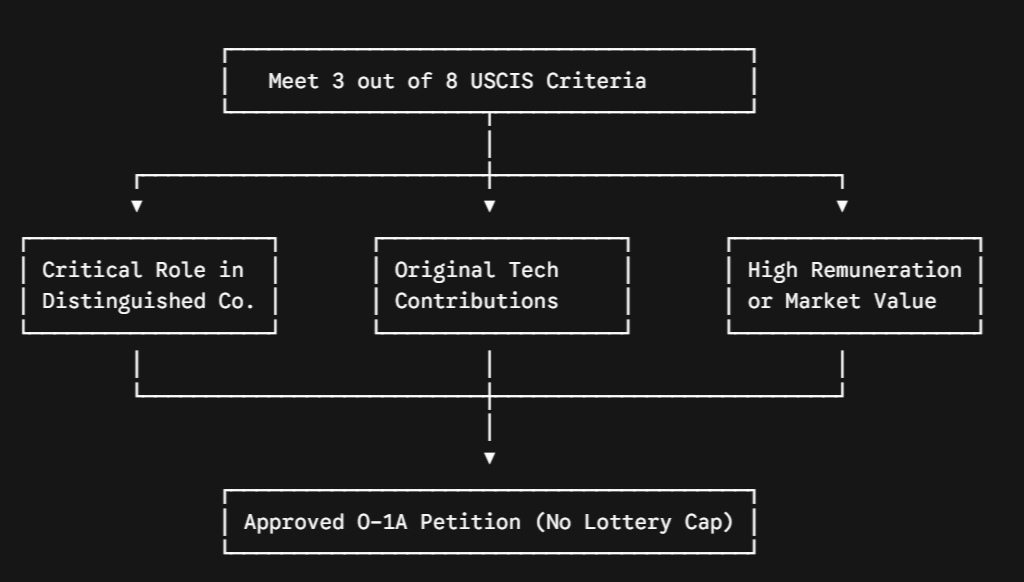
Core Qualifying Benchmarks for Tech Talent:
- Critical or Essential Role: Demonstrating that your startup has achieved significant distinction (e.g., backed by top-tier VCs, accepted into Y Combinator) and that the engineer’s contributions are vital to its technology roadmap.
- Original Contributions of Major Significance: Holding utility patents, authoring widely adopted open-source packages, or publishing foundational AI research papers.
- High Salary / Remuneration: Compensation (salary + equity value) positioned significantly above the average market rate for similar roles.
- Peer Judging: Serving as a peer reviewer for scientific journals, judging hackathons, or sitting on technical grant committees.
4. The Step-by-Step Corporate & Legal Action Plan
To successfully transfer an employee to the USA, follow this structured operational pathway.
1. Establish Corporate Entity & Governance: Weeks 1–3.
Incorporate your U.S. entity (typically a Delaware C-Corp). Ensure proper corporate separation between global entities through clear cap tables, parent-subsidiary structures, and board resolutions.
2. Gather Proof & Technical Documentation: Weeks 4–7.
Compile evidence for your petition. Gather repository commit metrics, architecture specs, press coverage, VC term sheets, academic citations, and 5 to 7 detailed expert advisory letters from industry authorities validating the engineer’s work.
3. File Form I-129 with USCIS: Week 8.
Work alongside an experienced startup immigration lawyer to draft and submit Form I-129 (Petition for a Nonimmigrant Worker). Utilize USCIS Premium Processing to secure an official decision or response within 15 calendar days.
4. Consular Processing & Onboarding: Weeks 9–12.
Once approved, the engineer attends an interview at a U.S. Embassy or Consulate in their home country for visa stamping, clears customs, and completes U.S. payroll setup (Form I-9, SSN registration).
5. Long-Term Mobility: Can an AI Engineer Qualify for an EB1A Green Card?
Temporary work visas establish immediate residency, but venture-backed companies must also plan long-term retention strategies.
Engineers specializing in fields like AI, deep tech, or robotics who successfully secure an O-1A status are often primed to pursue an EB1A for engineers. The EB1A is a first-preference employment-based green card that allows high-extraordinary-ability individuals to obtain permanent residence without undergoing the lengthy Labor Certification (PERM) process.
The Evolution: O-1A vs. EB1A
- Standard of Proof: While both visas share similar evidentiary categories, the EB1A requires demonstrating sustained national or international acclaim at the absolute top of the field.
- Green Card Intent: The O-1A is a dual-intent compatible temporary visa, whereas the EB1A grants immediate permanent legal residence.
- Strategic Timing: Moving an engineer to the U.S. on an O-1A gives them 1 to 3 years to speak at U.S. tech conferences, secure U.S. patents, and publish additional research—building an ironclad record for a subsequent EB1A green card filing.
Ready to Map Your Relocation Timeline?
Relocating key engineering talent demands careful legal planning and alignment with your business goals. Working with legal advisors specializing in tech companies such as the specialized team at Silicon Path Law, ensures your corporate architecture, employment contracts, and visa evidence meet strict USCIS criteria from day one.
Disclaimer: Attorney Advertising: The information on this website is provided for general informational purposes only and does not constitute legal advice. Viewing this website or communicating with Silicon Path PLLC (Silicon Path Law) does not create an attorney-client relationship. Legal advice can only be provided after a licensed attorney reviews your specific circumstances and a formal engagement is established. Prior results do not guarantee a similar outcome.