Image generated by Gemini
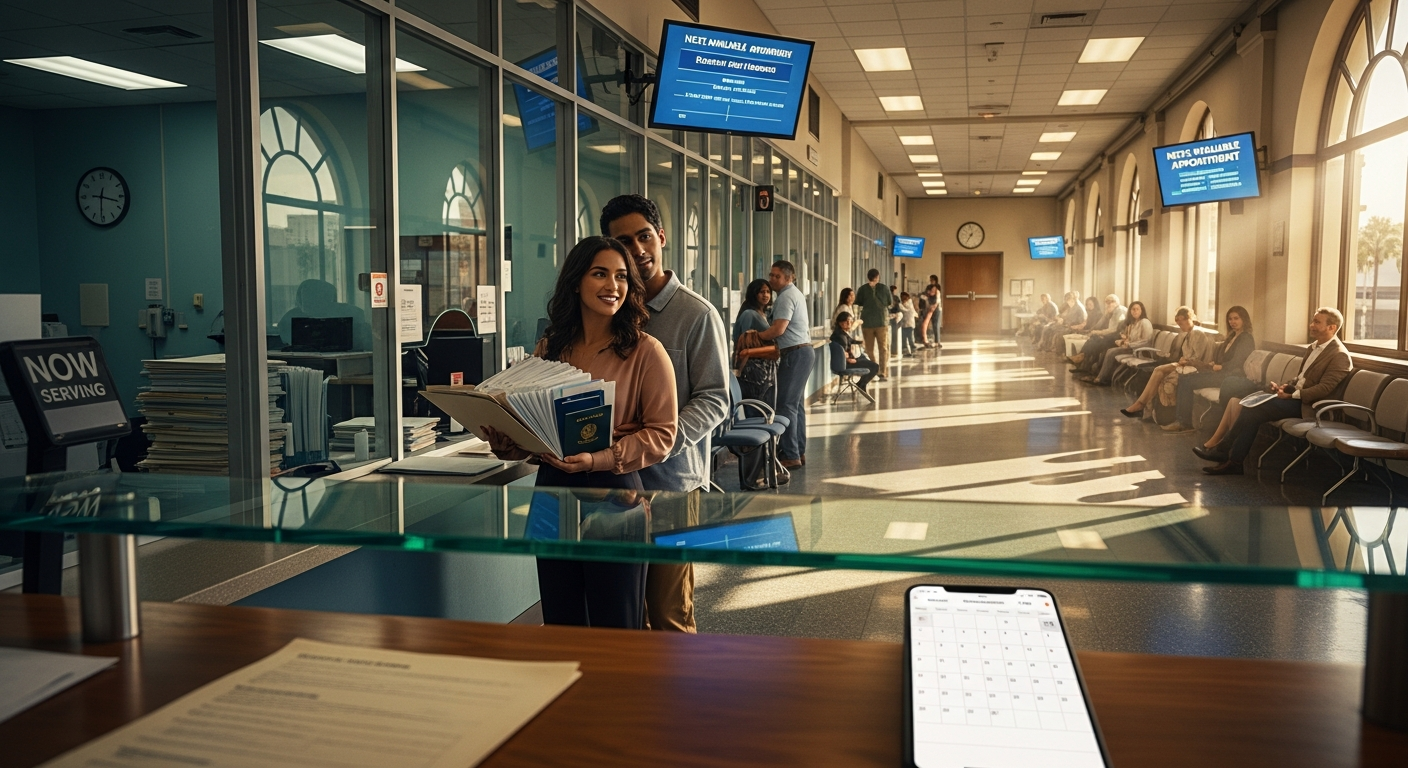
The countdown has begun. Your fiancé(e) has arrived in California on a K-1 visa, and the federal government gives you just 90 days to marry. But as you eagerly try to book that vital appointment with the county clerk to get a marriage license, you encounter an unexpected and formidable obstacle: no available slots for weeks, or in some cases, even months. This scenario is becoming a stressful reality for countless couples across the state, turning a time of celebration into one of anxiety.
In early 2026, a record-breaking number of marriage filings is causing significant appointment backlogs in major counties like San Diego and Los Angeles. This administrative bottleneck creates a direct conflict with the K-1 visa’s strict federal mandate, putting the immigration futures of many couples at risk. When a state-level administrative delay threatens to violate a federal immigration deadline, the consequences can be severe, potentially leading to a loss of legal status.
This guide clarifies the dual timelines you’re facing and provides an immediate action plan to navigate these bureaucratic delays. By understanding the problem and taking decisive, proactive steps, you can secure your legal status, meet your obligations, and successfully transition to the next stage of your life together in the United States.
The 90-Day Clock: Understanding the Two Conflicting Timelines
The primary source of confusion and stress for K-1 couples is the misunderstanding between two separate but equally important 90-day deadlines. One is a federal immigration requirement that is absolute and inflexible, while the other is a state-level administrative rule. Distinguishing between them is the first step toward creating a successful strategy to overcome appointment delays.
The Federal K-1 Visa Mandate
The most critical timeline is dictated by U.S. immigration law. The 90-day clock for a K-1 visa holder starts on the exact day they enter the United States. This is a non-negotiable, non-extendable federal deadline established by U.S. Citizenship and Immigration Services (USCIS). The purpose of the K-1 visa is for the foreign citizen to travel to the U.S. and marry their U.S. citizen sponsor within 90 days of arrival. Failure to marry within this window means the visa holder falls out of legal status, which can have severe immigration consequences, including the potential for removal proceedings and significant barriers to future immigration benefits.
California’s Marriage License Validity
The second timeline relates to the marriage license itself. The California Department of Public Health confirms that a California marriage license is valid for 90 days from the date it is issued by the county clerk. The wedding ceremony is required to occur within this specified timeframe. The core conflict for K-1 couples in 2026 is not the 90-day validity of the license, but the long wait time just to get the appointment to obtain it. This waiting period eats into the critical K-1 visa window, squeezing the time available to legally marry before the federal deadline expires.
| Feature | K-1 Fiancé Visa | California Marriage License |
| Start of 90-Day Period | The day of official entry into the U.S. | The day the license is officially issued by the county government. |
| Primary Requirement | Must get legally married to the U.S. citizen petitioner. | Must have a marriage ceremony within this window. |
| Governing Body | U.S. Citizenship and Immigration Services (USCIS) | California State and County Clerk’s Office |
| Consequence of Missing Deadline | Visa expires; holder is out of legal status. | License expires; a new one must be purchased. |
Why Are Marriage Appointments So Hard to Get in 2026?
The current appointment backlog is not an isolated incident but the result of several converging factors. Understanding the root causes can help couples appreciate the scale of the challenge and the importance of acting quickly. This is a systemic issue that reflects broader trends in both public demand and governmental administrative capacity.
A Perfect Storm of Demand
The delays can be attributed to several converging factors. Many analysts point to a sustained post-pandemic “wedding boom” as couples who postponed ceremonies are now moving forward. This pent-up demand, combined with a general increase in filings in early 2026, has overwhelmed the capacity of many county clerk offices, which were not scaled to handle such a sharp and prolonged spike in applications.
The Ripple Effect of System-Wide Delays
This local problem is connected to a broader national context of administrative backlogs. Recent reports highlight widespread delays across U.S. immigration and consular services, with some visa interview dates being pushed into 2027. Factors like staff shortages, budget constraints, and enhanced vetting procedures for all types of applications have slowed down government processing power at the federal and state levels. The effects of these federal slowdowns are now impacting the county level, which is the final administrative step for many processes like marriage licensing.
The Impact in High-Population Areas
The issue is most acute in major metropolitan areas such as Los Angeles, the Bay Area, and San Diego, where population density naturally leads to higher demand. These urban centers are struggling to keep up, leading to appointment calendars that are booked solid for months. In San Diego County, for instance, couples must not only find an appointment but also be prepared for the $129 fee for a public license. When appointment slots are scarce, the pressure mounts, as each passing day brings K-1 couples closer to their unchangeable federal deadline.
Your Action Plan: 5 Immediate Steps for K-1 Couples Facing Delays
Facing a bureaucratic delay can feel disheartening, but there is a clear path forward. The key is to be strategic, flexible, and urgent. This five-step action plan provides direct, actionable advice to help you secure a marriage license appointment and meet your legal obligations without jeopardizing your immigration status.
- Book the First Available Appointment—Anywhere
Do not wait for a “perfect” date, time, or even location. The moment the K-1 visa holder’s arrival in the U.S. is confirmed, your priority should be to get online and book the earliest available marriage license appointment you can find. Even if it is weeks or a month away, securing a spot on the calendar is the essential first step. Treat this as the most urgent item on your to-do list. - Expand Your Search to Neighboring Counties
This is the most critical and effective strategy for overcoming local backlogs. A marriage license issued by any county in California is valid for a marriage ceremony held anywhere within the state of California. If you live in San Diego and find no appointments, immediately check the online systems for Riverside, Orange, or Imperial counties. Often, more rural or less populated counties have significantly better availability, allowing you to secure an appointment in days rather than months. - Prepare All Your Documentation in Advance
Showing up to your appointment unprepared can cause further, devastating delays. Before your scheduled date, gather all essential documents. Both parties will need a valid, government-issued photo ID, such as a driver’s license or a passport for the K-1 visa holder. If either party has been married before, you must bring a certified copy of the final divorce decree or a death certificate to prove the previous marriage has ended. Ensuring all your paperwork is in order before the appointment is crucial. A comprehensive guide on K-1 Visa California Marriage License requirements can help you gather everything from foreign birth certificates to any necessary translations. - Separate the License from the Ceremony
Remember that the legal requirement is to obtain the license and have a valid marriage ceremony performed within the 90-day K-1 window. Your large celebration with family and friends can happen at any time. Once you have the marriage license in hand, you can arrange for a simple civil ceremony at a courthouse or have an authorized officiant perform a small, legally binding ceremony. The signed license must then be returned to the county clerk’s office within 10 days of the ceremony to be officially recorded. - Seek Professional Legal Advice
If your 90-day window is dangerously tight, if you have a complex prior marital history, or if other complications arise, consulting with an experienced immigration attorney is the safest course of action. An attorney can verify that all legal requirements are being met, offer strategies for dealing with unique circumstances, and ensure that the entire process is handled in a way that protects the subsequent, all-important adjustment of status application for a green card.
Protecting Your Future: Act Now to Meet the Deadline
The current marriage license appointment backlog in California is a serious logistical challenge, but it is a solvable one. By thinking creatively, expanding your search to other counties, preparing meticulously, and acting with urgency, you can successfully overcome this bureaucratic hurdle. The worst thing a couple can do is wait, hoping for an opening in their home country.
Don’t let an administrative delay derail the future you have worked so hard to build. The key to success is being proactive, prepared, and persistent. By taking these steps, you can confidently navigate this challenge, meet your legal obligations under federal law, and ensure a smooth and confident start to your life together in the United States.
Apart from that, if you want to know more about How to Choose the Right Divorce and Family Lawyer for Your Case then visit our Family Law category.
Frequently Asked Questions (FAQs)
A: No. A K-1 visa is issued for the specific purpose of marrying a U.S. citizen petitioner in the United States. The petition you filed with USCIS indicates an intent to marry and reside in a particular area. Marrying in a different state, especially one known for quick weddings like Nevada, can raise serious red flags with immigration officials during the adjustment of status interview. It may suggest that the marriage was not bona fide or that there was a change in intent, which could lead to a denial of the green card application.
A: The 90-day rule is strict and absolute. Once the 90th day passes, the K-1 visa is void, and the foreign fiancé(e) is considered out of legal status. There are no extensions or grace periods provided by USCIS for this visa category. Missing the deadline creates a significant legal barrier to adjusting status from within the U.S. and may result in the foreign partner needing to leave the country to avoid accruing unlawful presence.
A: While a confidential marriage license is legally valid in California, it is generally not recommended for immigration purposes. The records for a confidential marriage are sealed and can only be accessed by the couple. This can complicate the process when USCIS or other government agencies need to independently verify the marriage. A public marriage license creates a public record, making it much easier to obtain certified copies and for officials to conduct necessary background verification for the green card application.