Annual HIPAA risk assessments still consume hours you could spend on patient care or product code. IBM’s 2024 Cost of a Data Breach report pegs the average healthcare incident at $9.8 million—the industry’s costliest for 14 straight years. The Office for Civil Rights can also hit you with fines up to $1.9 million for a single uncorrected violation.
Manual spreadsheets can’t keep pace with cloud-first stacks. Vanta, a trust-management platform that plugs into AWS, GitHub, Okta, and 400 other services, removes roughly 82 percent of the manual evidence auditors usually request. In short, automating your HIPAA risk assessment is now a baseline requirement for risk containment.
Use this guide to compare ten HIPAA risk-assessment platforms and reach an audit-ready posture well before the 2026 deadline.
The guide below compares ten HIPAA risk-assessment automation tools, showing where each one fits—from lean digital-health teams to multi-hospital systems—so you can reach an audit-ready posture before the 2026 deadline.
How we chose these tools
G2 tracks more than 1,500 governance-risk-and-compliance products, and 440 made its 2025 Best Software Awards list (G2 Best Software Awards). To narrow that crowded field to ten HIPAA risk-assessment platforms, we scored each candidate against four weighted pillars:
- End-to-end automation. A contender must collect evidence, flag gaps, and refresh risk scores without weekly spreadsheet manual overhead. Partial “policy lockers” didn’t make the cut.
- Regulatory currency. We favored vendors that shipped meaningful updates after NIST SP 800-66 Revision 2 landed in February 2024, showing they track fresh OCR guidance instead of relying on legacy checklists.
- Verifiable outcomes. Public case studies, peer-review ratings, and quantified customer wins carried extra weight; unsubstantiated claims did not.
- Fit-for-budget scaling. A solo dentist shouldn’t pay enterprise rates, and a 20-clinic health system can’t run on a bare-bones checklist app. We mapped each tool’s price tier to its ideal head count and tech footprint.
These filters produced a roster that spans startups, private practices, and multi-site hospital networks, each one proven to shrink audit prep from weeks to days.
Segment A: Full-stack automation for digital-health and SaaS teams
For venture-backed health-tech startups, every sales questionnaire asks one make-or-break question: “Provide proof of HIPAA compliance.” The three platforms below plug into your repos and cloud accounts, so evidence gathers itself while your engineers ship features.

1. Vanta – evidence on autopilot
Vanta connects to AWS, GitHub, Okta, and more than 400 other services to automate HIPAA compliance. The platform then pulls configuration logs and access records in real time. An IDC white paper indicates teams spend 82 percent less time per framework once Vanta’s 1,200 automated checks run. One dashboard reveals passing and failing controls, and any fix syncs across HIPAA, SOC 2, and ISO 27001 mappings.
Ideal fit: seed-to-Series C startups that need audit-ready proof without hiring a full-time compliance analyst.
2. Scytale – continuous monitoring for multi-framework teams
Scytale installs read-only connectors across your cloud stack and runs 24/7 control monitoring, sending alerts the moment MFA turns off or an unencrypted device appears. Because each control maps once and appears in HIPAA, SOC 2, and ISO 27001 views, a password-length change in Okta updates three scorecards at once. Buyers cite a 4.8/5 rating across 500 G2 reviews and a 9.6/10 satisfaction score in 2025 governance-risk-compliance rankings.
Ideal fit: early-stage SaaS companies juggling two or more frameworks that want always-on visibility.
3. Aptible – Managed HIPAA Compliance for Developers
Aptible provides a container orchestration platform built from the ground up for HIPAA compliance. It handles the heavy lifting of encryption, backup, and audit logging, effectively isolating your development team from the complexity of infrastructure compliance.
Ideal fit: Digital health startups building directly on cloud infrastructure who need a “compliance-in-a-box” hosting environment.
Segment B: Guided suites for clinics and mid-sized providers
Independent practices juggle patient care, billing, and security paperwork, often with no IT staff. The four platforms below bundle risk assessments, policy templates, and coaching so compliance tasks fit between appointments.

4. Compliancy Group – “The Guard” with a live coach
Compliancy Group pairs its cloud portal with a dedicated Compliance Coach who reviews evidence and awards a HIPAA Seal of Compliance. According to HIPAA Journal, no client using The Guard has failed an OCR audit in eighteen years. On G2, the platform holds a 4.7-star rating from more than 80 reviews and ranks first for Auditing & Risk Assessment in 2025. Pricing is quote-based, typically scaled by provider count.
Ideal fit: clinics and dental offices that want hands-on guidance and a recognizable compliance badge.
5. Accountable HQ – one dashboard, zero spreadsheet chase
Accountable condenses HIPAA policies, BAAs, training, and incident logs into a traffic-light dashboard. A plain-language questionnaire produces a gap score and ranked task list. Public pricing begins at 99 dollars per month for the Essential tier. On Capterra, users give the platform 4.8 stars for ease of use.
Ideal fit: solo and small-group practices that need policies, vendor agreements, and staff attestations in one workspace.
6. HIPAAMATE – checklist automation on a lean budget
HIPAAMATE guides users through risk analysis, policy acceptance, and annual refreshers via a timeline view. Automated reminders track expiring BAAs and overdue training, then display progress on a color heat map. Plans list at about 199 dollars per month. Capterra reviewers award five stars for ease of use and support.
Ideal fit: practices with up to ten providers that prefer self-service software over consulting fees.
7. The HIPAA E-Tool – an auditor’s questionnaire, already digitized
The E-Tool recreates OCR-style questions online and rolls prior answers forward, cutting reassessment time. It exports a full risk-management plan and evidence PDF on demand. Subscriptions start near 129 dollars per month.
Ideal fit: non-technical offices that want exhaustive coverage and ready-made audit documentation at low cost.
Segment C: Enterprise-grade and specialty platforms
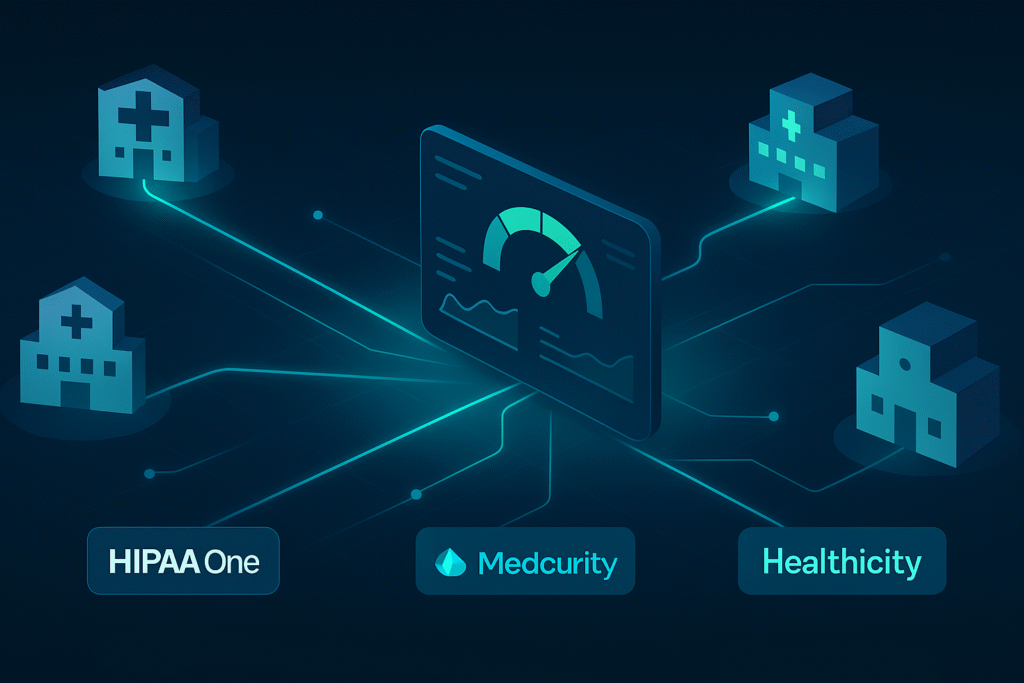
Regional health systems and multi-clinic groups must document safeguards across thousands of endpoints. The three platforms below automate evidence gathering at scale and deliver board-ready reports.
8. HIPAA One – audit-quality reports at hospital scale
HIPAA One guides teams through asset inventory, threat scoring, and NIST 800-30–based risk calculation, then outputs an OCR-ready report. The cloud service is used by more than 64,000 users/providers in 7,000 locations and reports 60 to 80 percent time savings versus manual spreadsheets. Annual licenses start around $2,500 per facility.
Ideal fit: integrated delivery networks and large practices that need defensible, NIST-mapped reports and task-level accountability.
9. Medcurity – collaborative risk analysis with role-based views
Medcurity splits the Security Rule into administrative, technical, and physical safeguards so privacy, IT, and compliance leaders can work in parallel. A progress bar shows real-time status, and the platform exports a board-ready action plan on completion. Public rates range from $1,800 per year for fewer than 20 employees to $6,600 for up to 250 staff.
Ideal fit: mid-size systems that want an intuitive, cloud-first assessment tool with optional consulting.
10. Healthicity Compliance Manager – unified oversight across regulations
Healthicity unites HIPAA, OSHA, hotline cases, and coding audits in one dashboard. On G2, reviewers give it 9.1 out of 10 for quality of support and 8.6 for auditing and risk assessment. Corporate teams can push a standard HIPAA checklist to dozens of clinics and watch completion roll up into a system-wide heat map. Pricing is quote-based.
Ideal fit: multi-state health systems that need cross-regulatory transparency without full GRC overhead.
Quick-compare: find your fit fast
Need a snapshot before booking demos? The grid below normalizes pricing to entry-level annual cost per clinic or company (monthly average in parentheses) and lists evidence-automation data when vendors publish it.
| Tool | Best for | Entry price** | Human support | High-value integrations |
| Vanta | Health-tech startups | $12,000 yr (~$1,000 mo) | Chat + compliance experts | AWS, GitHub, Okta |
| Scytale | Multi-framework SaaS | $9,600 yr (~$800 mo) | AI assistant + experts | Azure, GitLab, Google Workspace |
| TrueVault | Dev teams storing PHI | Usage-based (from $0.05 / record / mo) | Email / ticket | REST API, React SDK |
| Compliancy Group | Clinics & dental | $1,188 yr (~$99 mo) | Dedicated coach | EHR CSV import |
| Accountable HQ | Small practices | $1,188 yr (~$99 mo) | Email / chat | Google Workspace, Slack |
| HIPAAMATE | Solo providers | $2,388 yr (~$199 mo) | Self-service | N/A |
| HIPAA E-Tool | Non-technical offices | $1,548 yr (~$129 mo) | Email support | — |
| HIPAA One | Hospitals & IDNs | $2,500 yr per site | Phone / email | Microsoft 365, EHR feeds |
| Medcurity | Mid-size systems | $1,800 yr (< 20 staff) | Optional consulting | AD, vuln scanners |
| Healthicity | Multi-site systems | Quote | Account manager | Policy hub, incident module |
*Vendor-reported estimate; verify during your demo.
**Rounded; excludes add-ons such as training seats or extra frameworks.
Shortlist two or three candidates, then jump back to the deep-dive sections for feature context.
Why act now: OCR expects a current risk analysis, not a static documentation
The HIPAA Security Rule requires covered entities and business associates to complete a “regular and thorough” security risk analysis and update it as systems or threats evolve (45 CFR § 164.308 (a)(1)(ii)). Since the enforcement rule began, the OCR has levied over $140 million in penalties. In recent years, they have ramped up activity with the ‘Right of Access’ initiative.
Regulators now ask for proof of continuous risk management. Since the inception of the enforcement rule, the OCR has settled over 150 cases totaling more than $140 million in penalties. Recently, the agency has shifted focus to the ‘Right of Access’ initiative and specific security failures, signaling that documentation from three years ago is no longer sufficient.
Real-time automation changes the economics. When an automated GRC platform monitors controls every day, year-end reviews become a progress check, not a scramble. Deploy one of the tools above this quarter, and your next OCR request will meet an environment already tagged, logged, and tracked for remediation—helping your organization stay protected instead of scrambling with a blank worksheet full of screenshots.
Conclusion
The HIPAA Security Rule doesn’t reward heroics in December—it rewards disciplined, continuous risk management. The ten platforms above turn the annual security risk analysis into an always-on process: evidence collects itself, gaps surface early, and remediation stays on track. Pick the tier that matches your footprint (startup, clinic, or multi-site system), run a pilot with 1–2 tools, and judge them on three things:
- How much manual evidence they eliminate,
- How clearly they map findings to HIPAA controls and NIST guidance, and
- How quickly your team can close issues from a single dashboard.
Do that, and your next audit won’t be a scramble—it’ll be a status update.
Want to know about How Continuous Monitoring Keeps OT Environments Safe and Reliable Check out our Cyber Security category.
FAQ
A risk analysis inventories assets, identifies threats/vulnerabilities, scores likelihood/impact, and documents mitigation—mapped to HIPAA safeguards. A gap assessment compares your current controls to required/recognized practices. Good platforms do both: they quantify risk and generate a prioritized remediation plan.
During demos, ask for a live walk-through of integrations (e.g., AWS/Okta/GitHub) and watch evidence populate without uploads. Require timestamps, source attribution, and control-to-evidence links. If changing a setting in your environment doesn’t reflect in the dashboard within minutes/hours, it’s not real automation.
Yes. OCR expects a current, thorough analysis and ongoing risk management. Continuous checks catch issues (unencrypted devices, disabled MFA, stale BAAs) before they become findings. For small teams, this often reduces workload because reminders, reassessments, and reports are generated automatically.
Shortlist two vendors, connect a limited scope (one cloud account, IdP, and a sample repo), and run a 14-day bake-off. Score each on automated evidence coverage, false positives, clarity of remediation tasks, and how quickly engineers/compliance can resolve issues without spreadsheets.
At minimum: asset inventory, methodology, risk register with scores and owners, supporting evidence, decisions/rationales, remediation plan with due dates, and proof of periodic review. Your platform should export this bundle on demand and retain annual snapshots for look-back.