Roosevelt Boulevard carries twelve lanes of traffic through Northeast Philadelphia, and for decades it has ranked among the deadliest roads in the country. The corridor and the residential streets feeding it have produced a run of crashes severe enough that vehicles have left the roadway entirely and struck houses, porches, and parked cars on blocks where people were asleep.
Residents have pushed the issue into town halls and council offices, and the city has responded with a mix of enforcement, signal changes, and physical redesign. This piece covers what is driving the crashes, what has actually been done about them, and what a homeowner or injured resident should do in the first 72 hours after a vehicle ends up in their living room.
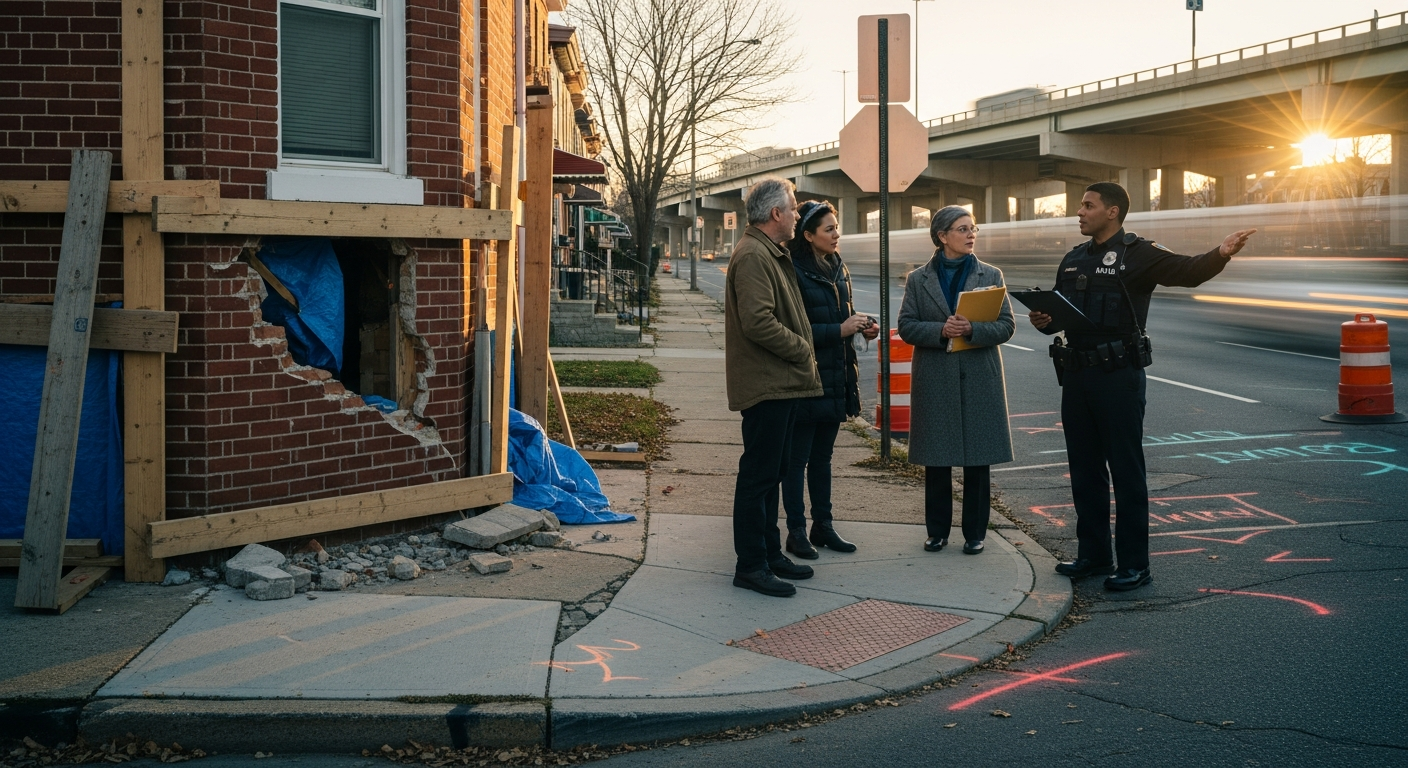
Illustration: Gemini.
Key Takeaways
- Road design is the common thread. Wide, straight, multi-lane arterials with frequent driveway cuts invite speed and produce high-energy crashes when a driver loses control.
- Pennsylvania has a 51 percent fault bar. An injured person recovers nothing if a jury assigns them more than half the blame, and the award is reduced by whatever share they carry.
- Claims against government agencies move on a six-month clock. Written notice is generally required within six months, far shorter than the two-year deadline for suing a private driver.
- Your auto tort election controls your rights. Pennsylvania drivers who chose limited tort gave up most claims for pain and suffering unless an exception applies.
- Homeowners insurance responds first when a car hits a house. Your carrier pays for the structure and then pursues the driver’s insurer for reimbursement.
Why This Corner of the City Keeps Getting Hit
Northeast Philadelphia was built out for cars. Wide arterials cut through dense rowhome and twin blocks, intersections are spaced far apart, and long straightaways encourage speeds well above the posted limit. When a driver runs off a road like that, the vehicle carries enough energy to cross a sidewalk, a small front yard, and a porch before anything stops it.
Several factors compound the geometry:
- Multiple through lanes in each direction, which make speeding feel safe and hide pedestrians from drivers in adjacent lanes
- Long distances between marked crossings, which push people to cross mid-block
- Heavy nighttime speeding, when enforcement is thinnest and impairment is most common
- Frequent left turns across several lanes of opposing traffic
- Rowhome blocks where the front wall sits a few feet from the curb, leaving no buffer
Neighbors interviewed by local news have made the point plainly, describing the collisions as not isolated events but part of a dangerous pattern. That framing matters legally as well as politically, because a documented history of crashes at one location supports a claim that the responsible agency had notice of a dangerous condition.
What the City and State Have Done
Philadelphia adopted a Vision Zero policy in 2016 with the goal of eliminating traffic deaths, and the city publishes a High Injury Network showing the small share of streets that produce most serious crashes. Roosevelt Boulevard sits at the center of that map.
Automated speed enforcement
Automated speed cameras have operated on Roosevelt Boulevard since 2020 under state enabling legislation. The program issues civil violations to the registered owner rather than points against a license, and city and PennDOT reporting has credited it with steep drops in the number of drivers traveling far above the limit at camera locations.
Engineering changes
Enforcement alone does not fix geometry. The measures that reliably reduce run-off-road crashes are physical: shortening crossing distances with concrete islands and curb extensions, adding leading pedestrian intervals at signals, narrowing travel lanes, installing protected turn phases, and placing bollards or reinforced barriers where the roadway sits close to occupied buildings. Because Roosevelt Boulevard is a state route, major changes there require PennDOT coordination, which is why projects on that corridor move slower than paint-and-signal work on city streets.
Legal Recourse After a Vehicle Hits Your Home
Three sources of recovery usually exist at once, and they interact.
The first is your own homeowners policy. Dwelling coverage pays to repair the structure, other structures coverage handles fences and detached garages, personal property covers contents, and loss of use pays for a hotel or rental while the house is uninhabitable. Your insurer then subrogates against the driver, which is how your deductible typically comes back to you.
The second is the driver’s liability coverage, which responds to property damage and bodily injury. Minimum policies in Pennsylvania are modest, and a car through a front wall can exhaust them quickly, so counsel looks for umbrella coverage or a commercial policy if the driver was working.
The third is a claim against a government agency for a dangerous roadway condition. These are the hardest claims to win and the easiest to lose on procedure. A firm such as Philadelphia’s SuperLawyer Greg Prosmushkin will typically send preservation letters and a formal notice immediately, because the deadline runs from the crash and not from the day you finish repairs.
The rules that decide these cases in Pennsylvania
- Two-year deadline. Suits for personal injury and property damage against a private driver generally must be filed within two years of the crash.
- Six-month notice for government claims. Claims against the city or the Commonwealth generally require written notice within six months, and missing it can bar the claim outright.
- Damage caps. Pennsylvania caps recovery against a local agency at $500,000 in the aggregate, and against the Commonwealth at $250,000 per plaintiff and $1 million per incident.
- Narrow immunity exceptions. Agencies are immune except in defined categories, and roadway claims must fit the real property or streets exception rather than a general complaint about design choices.
- Modified comparative negligence. Damages are reduced by your share of fault, and recovery is barred above 51 percent.
Limited Tort: The Choice Most Drivers Forget
Pennsylvania lets drivers choose between limited tort and full tort when they buy auto insurance. Limited tort lowers the premium but gives up the right to recover for pain and suffering unless the injury meets an exception, most commonly a serious impairment of body function. Medical bills and wage loss remain recoverable either way, and personal injury protection benefits pay medical costs regardless of fault, starting at the statutory minimum of $5,000.
People injured on their own porch or sidewalk are often surprised to learn that this election can follow them, because it applies to injuries arising from the maintenance or use of a motor vehicle. Pull your declarations page and check which box you selected before you assume what your claim is worth. Crashes like these do lasting damage to the fabric of Northeast Philadelphia, and the insurance decision made years earlier often determines how much of that damage gets paid for.
What to Do in the First 72 Hours
- Get everyone out and let the fire department clear the structure before anyone reenters. Struck rowhomes can have compromised load-bearing walls and ruptured gas lines.
- Get the police incident number, the responding district, and the driver’s name, insurer, and policy number.
- Photograph everything before cleanup: tire marks, the point of impact, damaged curb or sign, interior damage, and the vehicle’s final resting position.
- Report the loss to your homeowners carrier the same day and ask specifically about loss of use benefits.
- Request the Department of Licenses and Inspections report and keep every notice, since it documents the severity of the structural damage.
- Do not sign a release or accept a quick check from the driver’s insurer while the repair scope is unknown.
- Preserve nearby video. Doorbell and business cameras usually overwrite within two to four weeks.
Frequently Asked Questions
Who pays when a car crashes into my house in Philadelphia?
Your homeowners insurer normally pays first for structural repairs, contents, and temporary housing, then recovers from the driver’s liability carrier. If the driver was uninsured or underinsured, your own policy limits and any available umbrella coverage become the practical ceiling.
Can I sue the city over a dangerous intersection?
Sometimes, but the path is narrow. Governmental immunity applies unless the claim fits a defined exception, you must give written notice within roughly six months, and statutory caps limit the recovery. Prior crash reports and complaints at the same location are the strongest evidence, because they establish notice.
How long do I have to file a claim after a crash?
Two years from the crash for most personal injury and property damage claims against a private driver in Pennsylvania. Claims involving a government agency require much earlier written notice. Insurance policies also impose their own prompt-notice conditions, so do not wait on those either.
Do speed cameras actually reduce crashes?
Automated enforcement consistently reduces the number of drivers traveling far above the limit, and lower speeds mean fewer severe injuries. It works best paired with engineering changes, since cameras only affect behavior at the camera location while narrower lanes and shorter crossings change behavior along the whole corridor.
What if I have limited tort coverage?
You can still recover medical expenses, wage loss, and property damage. Pain and suffering requires meeting an exception, most often serious impairment of a body function, which turns on medical proof of permanence rather than the size of the bills. Have a lawyer review the medical records before conceding the point.
Related Reading
The Bottom Line
Northeast Philadelphia traffic crashes are a design problem with a legal aftermath. Enforcement cameras and signal timing help, but the fixes that keep cars out of front rooms are physical ones, and they take state and city coordination. For anyone already hit, the deadlines are what matter most: six months for a government claim, two years for everything else, and a few weeks before the video evidence disappears.