When someone is hurting you or threatening you, a judge can order that person to stop. That court paper is an order of protection. Almost every detail changes once you cross a state line. This guide covers the tiers, who can ask for one, what a judge can forbid, and what a violation costs.
Short answer: A protective order is a civil court order that bars one person from contacting, approaching, or harming another. Judges issue them in tiers. Emergency versions last days. Temporary versions run weeks, and final versions run months or years. Breaking one is a crime in every state.
The three tiers at a glance
| Tier | Other names you may hear | Who is in the room | Typical length |
| Emergency | ex parte order, emergency protective order | You and the judge, sometimes a police officer | Same day up to about 21 days |
| Temporary | interim order, temporary restraining order | Usually just you, until the other side is served | Until the full hearing, often 14 to 30 days |
| Final | plenary order, permanent order, final protective order | Both sides, with evidence and witnesses | Six months to two years, renewable in most states |
Key takeaways
- Names change by state. Restraining order, protective order and order for protection often describe the same relief.
- Emergency relief is fast and one-sided. Lasting relief requires a hearing where the other person can respond.
- A judge can order no contact and distance from your home. Removal from a shared residence and firearm surrender sit on the same menu.
- Violating the order is a separate crime, and police in many states must arrest on reasonable cause.
- Filing is usually free in domestic violence cases, and court clerks hand out the forms.
- Treat the paper as a legal tool, not a shield. Pair it with a safety plan built with a local advocate.
What the order really is
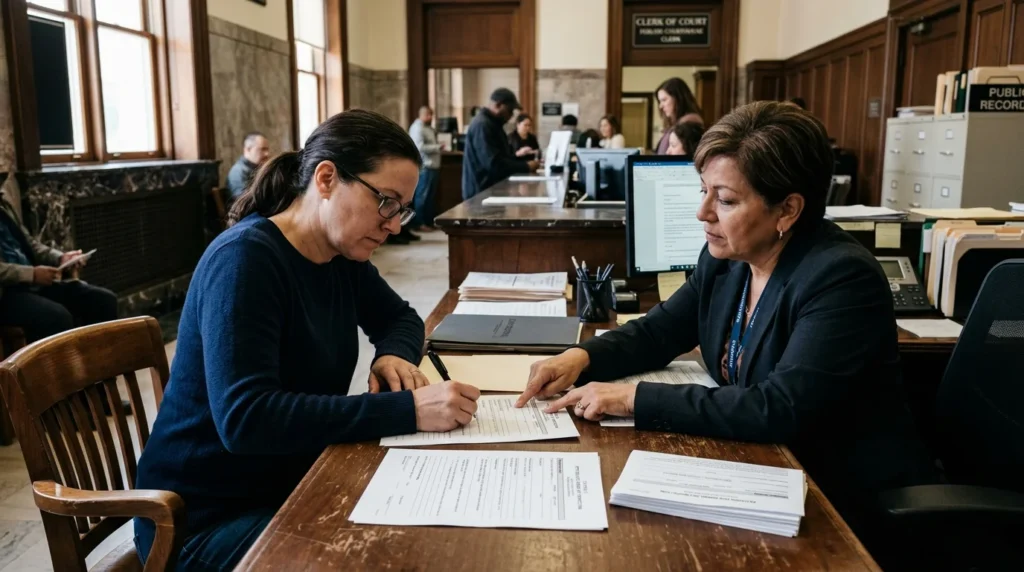
It is a civil court order of protection, signed by a judge, naming two people. You are the petitioner. Whoever gets restrained is the respondent. Everything in the order is an instruction to the respondent, and police enforce it on sight.
Getting one does not put anybody in jail by itself.
No conviction happens, and the respondent is not charged with a crime just because a judge signed the order. Many people hold a protective order while a separate criminal case moves through a different courtroom on its own schedule. Your civil case runs on a lower burden of proof. That is why a prosecutor can drop charges while your order stays intact.
That split confuses people. Criminal courts issue their own no-contact conditions inside a bail package or a sentence, and those expire with the case. Your civil order runs on its own timeline and belongs to you.
Restraining order, protective order, order of protection: one idea, many labels
New York and Illinois courts say order of protection. Texas and Virginia say protective order. California mostly says restraining order. Relief behind those words is broadly similar, but read a Texas article before filing in Ohio, and you arrive at the clerk’s window holding the wrong form.
Some states use the labels to mean genuinely different things. In parts of the country, a restraining order handles property and money during a divorce, while a protective order handles violence. For the precise legal sense of a term, Black’s Law Dictionary definitions are a reasonable starting point. Your state statute is still the version that binds a judge.
Your fix takes one minute. Search your state’s name plus the phrase, land on a court page ending in .gov, then use whatever that page calls it. Clerks will tell you the local name over the phone too.
Who qualifies to file
Domestic violence statutes usually require a relationship. Common categories include spouses, former spouses and dating partners, plus anyone who shares a child with you, blood relatives, and people who live or lived in the same home. Several states now add anyone in a “continuing personal relationship,” a phrase that sweeps in situations older statutory lists quietly missed.
Not every order needs that relationship. Most states offer separate stalking, harassment or sexual assault orders a stranger’s victim can file. Georgia lets an employer petition when the danger follows a worker to the job site. A parent can file for a child, and some states let a mature minor file alone.
Judges routinely fold temporary custody and support terms into these orders. Treat them as short-term scaffolding, not a settled custody decision.
How long each tier lasts, and the gap in between

Illinois is a clean example of the ladder. An emergency order of protection there protects you for up to three weeks, and a plenary order granted after a full hearing can run up to two years. Georgia works differently. An ex parte hearing there can happen the day you file; the full hearing is generally set within 30 days, and that order typically holds for six to 12 months.
Notice the middle.
Between the emergency signature and the full hearing sits a window of two to four weeks in which the respondent knows you filed. Advocates treat that stretch as the highest risk period of the process, because service is often when the other person first learns anything.
Plan for it. Ask the Court when service will be attempted, and tell your workplace and your child’s school who is not allowed near. Renewal usually requires a fresh motion filed before the expiration date, so put that date in your phone the day you receive the order.
What an order of protection can prohibit
Judges pick from a menu, and the menu is wider than most people expect. Typical provisions include:
- No contact of any kind, including texts, calls, social media and messages passed through friends
- Stay away from your home, workplace, school and vehicle
- Removal from a shared home, even when the respondent’s name is on the lease
- No contact with your children, or supervised exchanges only
- Surrender of firearms and ammunition, plus a bar on buying more
- Payment of rent or medical bills, and mandated counselling
- Return of your phone, documents, keys, or pets
Firearm surrender is settled federal law now, not a state quirk.
A Second Amendment challenge reached the US Supreme Court, which answered in its Rahimi decision of June 21, 2024. The Court concluded that a judge who finds “a credible threat to the physical safety of another” may order firearms surrendered. That ruling upheld Section 922(g)(8) of Title 18, which bites while a qualifying order stays in force.
Whether your county sheriff actually turns up and collects the guns is a separate question. Ask the judge and the clerk how enforcement works where you live.
Ask for what you need. A judge cannot grant a provision nobody requested, and petitioners often leave out the workplace address or the pet because no form prompted them.
How to file, step by step
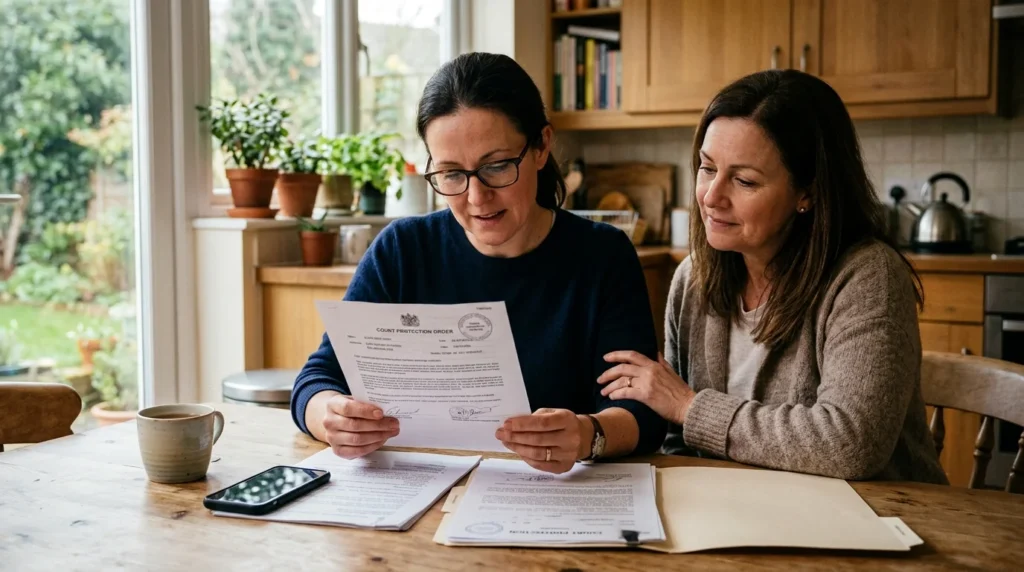
- Call an advocate first. A local domestic violence advocate knows your county’s forms and timing. The National Domestic Violence Hotline at 1-800-799-7233 will connect you to one.
- Go to the right clerk. Usually the circuit, superior, or family court in the county where you live, where the respondent lives, or where the abuse happened. Bring photo identification.
- Fill out the petition. Write dates and specifics. “He grabbed my wrist on April 3, 2026 and left bruises” carries far more weight than “he is abusive.”
- Attach your evidence. Photos, screenshots, medical records, police report numbers, and witness names. Print copies rather than relying on your phone.
- See the judge that day. Most courts hear emergency requests without the respondent present. Answer directly and do not minimise.
- Get the respondent served. A sheriff’s deputy or process server delivers the papers, usually free in domestic violence cases, and nothing binds the respondent until service happens.
- Show up to the full hearing. This is a contested civil proceeding, much like the disputes litigation attorneys handle in civil Court, with testimony and cross-examination. Missing it is the most common reason a case dies.
- Distribute certified copies. Keep one on you, leave another with your employer and your child’s school, and store a photo in the cloud.
Filing costs nothing in most domestic violence cases. Georgia charges $0 under its Family Violence Act, and federal funding conditions push other states the same way. Where a court does charge, usually on a stalking petition, the fee sits under $100. Clerks keep waiver forms behind the counter.
What a violation means
Contact is contact. Physical harm is not required. If the respondent shows up somewhere the order forbids, call the police. In New York, officers must arrest when there is reasonable cause to believe an order was violated, and a criminal contempt conviction can carry up to seven years in jail.
Penalties elsewhere vary widely. A first violation is often a misdemeanor, while repeat violations or violations involving a weapon climb to felony territory. That exposure is criminal, so a respondent facing a charge should understand what a criminal lawyer handles before talking to investigators.
You also have a civil path. A violation petition in family court can extend the order or add restrictions, though it rarely produces an arrest. Log every incident with a date, a time, and a screenshot, because a documented pattern beats anyone’s recollection months later.
What the paper cannot do
An order of protection does not physically stop anyone.
It creates consequences after the fact, and it gives police a reason to act fast rather than treat the situation as a private dispute. Research on protective orders is genuinely mixed on whether they reduce repeat abuse, and honest advocates say so rather than promising safety.
So treat it as one layer. Change your locks and your passwords, vary your routine, and build a safety plan with an advocate who knows local shelter capacity. If the respondent has a history with firearms, raise it with the judge explicitly.
If an order is filed against you

Take it seriously. Read every line and obey all of it, including the parts you believe are false.
Do not text, and do not send a friend to explain on your behalf. Contact through a third party is still contact in most states, and a single reply can turn a civil dispute into a criminal charge. Save every message you receive too.
Then get to the hearing with a lawyer. A final order can cost you your home, your firearms, a professional license, and time with your children. Petitions often surface during a separation, which is one reason strategy around who files for divorce first comes up so often.
Your next step
Do not wait. Rules, names, and timelines differ in every state, so verify yours before acting. Call your county court clerk and ask what the order is called locally and when the emergency docket sits.
Then call the National Domestic Violence Hotline at 1-800-799-7233 for an advocate who can sit with you through the forms. This article explains the system, and it is not a substitute for advice from an attorney who knows your state. If you are in immediate danger, call 911 first.
Frequently asked questions
Emergency versions typically run for days to three weeks. Final versions commonly run six months to two years, and several states allow lifetime orders in severe cases. Renewal requires a motion filed before the current one expires.
A civil order is not a conviction, so it does not appear on a standard criminal history. It does go into state and federal law enforcement databases, and it can surface in firearm purchase checks, security clearance reviews, and employment screening that touches court records.
Yes. Federal law requires states and tribes to enforce a valid order issued elsewhere, and you do not have to register it first. Registering it locally is still worth doing, because officers verify orders faster when they appear in their own system.
You can file alone, and the forms are written for people without lawyers. Representation matters most at the contested final hearing, especially when the respondent brings counsel. Legal aid offices often take these cases for free.
Doing so puts the respondent at risk, because only a judge can modify the order and prosecutors can act regardless of who made contact. If circumstances change, file a motion to modify or dismiss instead.
Your sworn testimony can be enough. Photographs, medical records, threatening messages, and police reports strengthen it considerably. Bring whatever exists, organised by date.