


Navigating the Aftermath of a DWI Accident in Harris County
When the unexpected happens – a DWI arrest coupled with property damage – the immediate aftermath can be chaotic and frightening. This is particularly true in Houston’s Harris County, which consistently records more DUI-involved collisions than any other part of Texas. As a sprawling metropolitan area with millions of drivers, the sheer volume of traffic contributes to a higher potential for accidents. Annually, drunk drivers are responsible for over 20,000 crashes statewide, underscoring the serious nature of these incidents. The legal and personal repercussions can be profound, making it imperative to understand the charges you face and the legal avenues available.
Immediately following an accident, the scene is often confusing. You must deal with the other party involved, exchange information, and wait for law enforcement to arrive. However, if the responding officer suspects you have been drinking, the focus of the investigation can shift dramatically from a simple traffic accident to a criminal DWI investigation. The stress of the collision is suddenly compounded by the fear of arrest, jail time, and a permanent criminal record. This dual-crisis scenario is what makes these cases so challenging from the very beginning.
Navigating the complexities of a DWI with property damage case involves understanding two distinct, yet interconnected, legal areas. It’s not a single, consolidated charge, but rather a combination of offenses that carry their own set of legal definitions and penalties. This approach gives prosecutors significant leverage; they can pursue both charges aggressively, potentially using one as a bargaining chip against the other during plea negotiations. Understanding this strategic legal landscape is the first step toward building an effective defense.
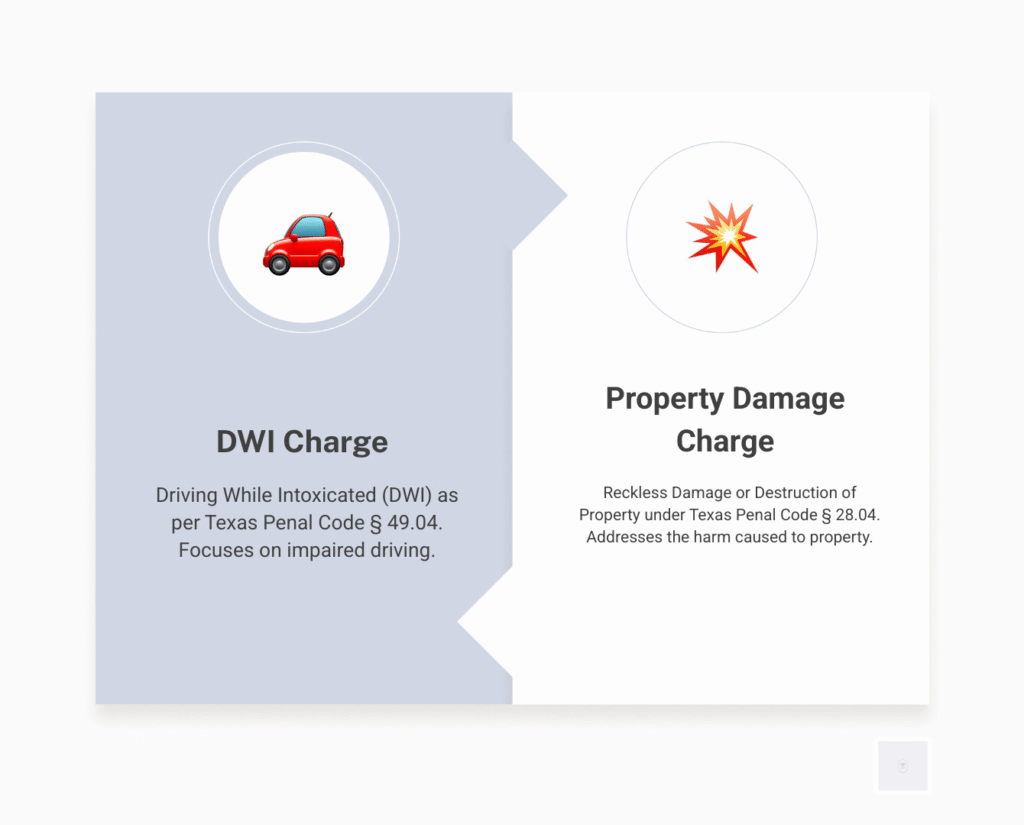
To clarify, let’s look at how these charges typically break down under Texas law:
What Constitutes a DWI with Property Damage in Texas?
In Texas, there isn’t a single, unified statute specifically titled “DWI with property damage.” Instead, when an intoxicated driver causes an accident resulting in damage, they are typically charged with two separate offenses: Driving While Intoxicated (DWI) under Texas Penal Code § 49.04 and Reckless Damage or Destruction of Property under Texas Penal Code § 28.04. This dual-charge approach allows prosecutors to address both the impaired driving aspect and the harm caused to property.
The decision to pursue both charges, and the severity of each, often lies with the prosecutor’s discretion, influenced by factors such as the extent of damage, the driver’s Blood Alcohol Concentration (BAC), and any prior offenses. For example, a driver with a high BAC who causes significant damage is more likely to face an aggressive prosecution on both fronts than a driver with a borderline BAC who caused a minor fender-bender.
The DWI Charge: Proving Intoxication
The core of any DWI charge in Texas is proving intoxication. According to Texas law, a person is considered intoxicated if they:
- Have a Blood Alcohol Concentration (BAC) of 0.08% or higher. This is the legal limit for adults 21 and over. For commercial drivers, the limit is 0.04%, and for those under 21, any detectable amount of alcohol can lead to a charge.
- Have lost the normal use of their mental or physical faculties due to alcohol or drug consumption, regardless of their BAC.
To establish intoxication, law enforcement typically relies on several pieces of evidence:
- Field Sobriety Tests (FSTs): These roadside tests (e.g., Horizontal Gaze Nystagmus, Walk-and-Turn, One-Leg Stand) are designed to assess a driver’s physical and mental impairment. However, their administration and scientific validity can often be challenged. For instance, the Walk-and-Turn test requires a suspect to take nine heel-to-toe steps along a line, turn in a specific manner, and walk back. An officer may count “clues” of impairment if the suspect starts too soon, loses balance, or uses their arms to balance. Defenses can arise if the officer gave incorrect instructions, the ground surface was uneven, or the suspect had pre-existing medical conditions affecting their balance.
- Breathalyzer Results: If a breath test is administered, a reading of 0.08% or higher provides direct evidence of intoxication. However, these machines are not infallible. They require regular calibration and maintenance, and results can be skewed by factors like mouth alcohol, acid reflux, or improper operation by the officer.
- Blood Tests: Often considered more accurate than breath tests, blood samples can also conclusively prove BAC levels. Texas’s Implied Consent Law means that by operating a vehicle, you automatically consent to a chemical test if lawfully arrested for DWI. Refusal can lead to an automatic license suspension through a separate civil proceeding called an Administrative License Revocation (ALR) hearing, even if you are later found not guilty of the DWI. If a driver refuses, police can, and often will, quickly obtain a warrant from a judge to perform a mandatory blood draw.
The Property Damage Charge: Reckless Damage or Destruction
The property damage component of these incidents falls under Texas Penal Code § 28.04, which defines “Reckless Damage or Destruction.” This offense is typically charged as a Class C Misdemeanor, the lowest level of criminal offense in Texas, punishable by a fine only.
To secure a conviction for reckless damage, the prosecution must prove that the driver acted recklessly in causing the damage. This means they were aware of but consciously disregarded a substantial and unjustifiable risk that their actions would cause property damage. In a DWI context, the act of driving while intoxicated often serves as the basis for proving recklessness, as impaired judgment inherently increases the risk of an accident. The prosecution’s argument is straightforward: an intoxicated person knows or should know that getting behind the wheel creates a high risk of causing a collision.
The penalties for a Class C Misdemeanor are generally less severe than those for a DWI. A conviction can result in:
- Fines up to $500.
- Court-ordered restitution to the property owner for the cost of repairs or replacement. This is a crucial aspect, as it directly addresses the financial impact on the victim. Restitution is not a fine paid to the state; it is a direct payment to the person whose property was damaged. The amount is determined by evidence such as repair estimates or the fair market value of the property if it was destroyed. Failure to pay court-ordered restitution can result in further legal consequences, including a violation of probation.
These two charges, DWI and reckless damage, are often pursued simultaneously, leading to a complex legal battle on multiple fronts that requires careful and strategic navigation.
The Dual Consequences: Criminal Penalties and Civil Liability
A DWI with property damage conviction in Houston triggers a cascade of consequences, impacting both your criminal record and your financial standing. These cases involve separate criminal and civil proceedings, each with distinct goals and outcomes. While the criminal court focuses on punishment for breaking the law, the civil system aims to compensate victims for their losses. Successfully navigating these parallel legal systems requires a deep understanding of prosecutorial tactics and civil negotiations. This is where the experience of a Former prosecutor Houston DWI defense attorney becomes invaluable, as they can anticipate the state’s strategy in the criminal case while simultaneously advising on how to manage civil liability.

Criminal Penalties for a Conviction
The criminal penalties for a DWI in Texas are severe and escalate significantly with prior offenses or aggravating factors. When property damage is involved, even if charged as a separate Class C misdemeanor, it often contributes to the overall perception of the offense’s seriousness and can influence plea negotiations or sentencing. A prosecutor may be less willing to offer a favorable plea deal when a victim has suffered tangible financial loss.
Here’s a general overview of potential criminal penalties for DWI, which would be compounded by a reckless damage conviction:
Offense Category Fines (up to) Jail Time License Suspension (up to) Additional Consequences 1st Offense (Class B Misdemeanor) $3,000 72 hours to 180 days 90 days to 1 year DWI education program, possible Ignition Interlock Device (IID), annual surcharges up to $2,000 for 3 years to retain license. 2nd Offense (Class A Misdemeanor) $4,500 30 days to 1 year 180 days to 2 years Mandatory IID, DWI education program, community service. 3rd+ Offense (3rd Degree Felony) $10,000 2 to 10 years in prison 180 days to 2 years Mandatory IID, loss of right to vote and own firearms, significant prison time. Civil Liability and Financial Fallout
Beyond the criminal courthouse, you will almost certainly face civil liability for the damage you caused. This process runs parallel to your criminal case and is handled through insurance claims or a civil lawsuit.
- Insurance Claims: The owner of the damaged property will file a claim against your auto insurance policy. Your insurance company will investigate the accident and pay for the covered damages, such as repair costs. However, a DWI-related accident can cause your insurer to dramatically increase your premiums or even cancel your policy at the next renewal period.
- SR-22 Requirement: A DWI conviction will trigger an SR-22 requirement. This is not an insurance policy itself, but a certificate of financial responsibility that your insurance provider files with the state. It proves you carry the state-mandated minimum liability coverage. You will likely be required to maintain an SR-22 for at least two years after your conviction, and the insurance policies that include an SR-22 filing are significantly more expensive.
- Civil Lawsuit: If you are uninsured, underinsured, or if the damages exceed your policy limits, the victim can sue you directly in civil court. They can seek compensation for:
- Repair or Replacement Costs: The full cost to repair their vehicle or its fair market value if it was totaled.
- Loss of Use: Costs associated with not having their vehicle, such as rental car fees.
- Diminished Value: Compensation for the loss in the vehicle’s resale value, even after it has been fully repaired.
A civil judgment against you is a legally enforceable debt. If you don’t pay, the victim can take further legal action to collect, such as garnishing wages or placing a lien on your property. These dual legal battles underscore the importance of a comprehensive defense strategy that addresses both the immediate criminal charges and the long-term financial consequences.
Want to know about Building Blocks for Law, Business, and Public Services Check out our Legal Advice category.







