In South Carolina, the abortion debate centers not only on moral and medical arguments but also on constitutional interpretation—especially the right to privacy under the state constitution. In South Carolina, the intersection of state supreme court rulings, abortion rights advocacy, and the implementation of fetal heartbeat legislation has created a complex and evolving legal framework surrounding abortion.
Over the past several years, the South Carolina Supreme Court has wrestled with conflicting statutes and constitutional protections, abortion rights groups have launched high-stakes litigation, and the legislature has increasingly relied on fetal heartbeat or six-week bans to curb abortion access.
This article maps how those three forces—judicial rulings, advocacy efforts, and heartbeat legislation—intersect in shaping the SC Abortion Law and its impact on women’s rights and privacy in South Carolina today.
| Aspect | Key Details |
| Law Name | South Carolina Fetal Heartbeat and Protection from Abortion Act |
| Main Rule | Bans most abortions after a fetal heartbeat (~6 weeks) is detected. |
| Exceptions | Rape, incest (up to 12 weeks), fatal fetal anomaly, or risk to the mother’s life. |
| Court History | – 2023: Law struck down for violating privacy rights. – 2024: Revised law upheld by new conservative Supreme Court. |
| Privacy vs. Legislation | Shift from privacy protection to deference to the legislature on moral grounds. |
| Impact on Providers | Only doctors can perform abortions; telemedicine is banned; there is a risk of criminal penalties. |
| Impact on Patients | Limited access; rural and low-income women are most affected, forced to travel out of state. |
| Public Reaction | – Pro-choice groups: Violation of bodily autonomy. – Pro-life groups: Moral and fetal protection success. |
| Medical Debate | “Fetal heartbeat” term seen as scientifically vague; critics cite misuse of medical terminology. |
| Future Outlook (2025) | Proposals to tighten restrictions and possibly remove exceptions. |
Historical and Legal Background: Abortion, Federal Shift, and State Autonomy

The End of Roe and State Control
The U.S. Supreme Court’s decision in Dobbs v. Jackson Women’s Health Organization (2022) ended the federal constitutional right to abortion, returning regulatory authority to states. Since then, many states, including South Carolina, have enacted restrictive laws, triggering constitutional conflicts at the state level.
South Carolina’s Pre-Dobbs Regulation
Before Dobbs, South Carolina had some restrictions (parental consent, waiting periods, etc.), but no near-total bans. Post-Dobbs, the state legislature moved to adopt more aggressive restrictions, notably fetal heartbeat legislation.
The Fetal Heartbeat Legislation: From 2021 to 2023 and Beyond

The 2021 Fetal Heartbeat Act
In 2021, the South Carolina General Assembly passed the Fetal Heartbeat and Protection from Abortion Act, which sought to ban abortions once “cardiac activity” is detected (often approximately at six weeks). That law included limited exceptions, such as risk to the mother’s life, rape, incest, and fatal fetal anomalies.
A federal court quickly enjoined its enforcement after Planned Parenthood and others challenged it.
2023 Revisions and New Act
After the South Carolina Supreme Court struck down the 2021 Act (on privacy grounds), the legislature revised its approach and passed a new version in 2023 (S.B. 474). The 2023 Act retained the same “heartbeat” language but added stronger legislative findings and wording designed to withstand judicial scrutiny.
In May 2025, the South Carolina Supreme Court again reviewed challenges to the 2023 Act and upheld it, ruling that it could be enforced, effectively reinstating a six-week ban.
Key Issues in Heartbeat Laws
- Ambiguity in “fetal heartbeat” definition: The statute defines it as “cardiac activity, or the steady, repetitive rhythmic contraction of the fetal heart, within the gestational sac.” Critics argue this could allow a ban earlier than six weeks or delay enforcement.
- Exceptions and access: The law allows abortion in cases of rape, incest (if reported), fetal anomalies, and when the mother’s life is endangered.
- Enforcement mechanisms: Physicians and providers face civil or criminal penalties for violating these regulations.
State Supreme Court and the Right to Privacy in South Carolina
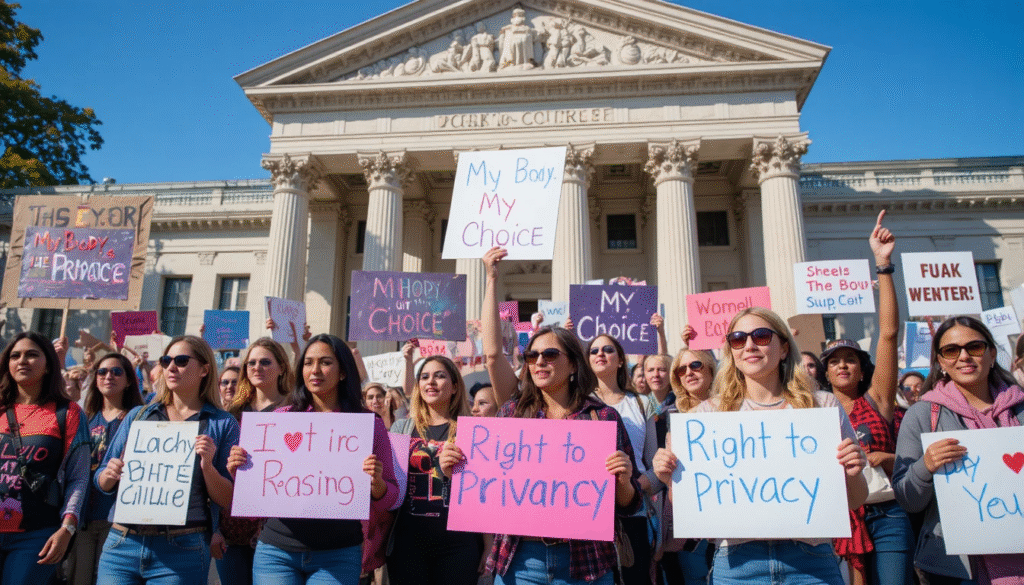
Under South Carolina’s Constitution (Art. I, § 10), citizens have protection from “unreasonable invasions of privacy.” The central legal battle has been whether choosing to terminate a pregnancy is a “private” decision protected by that clause.
In Planned Parenthood South Atlantic v. South Carolina, the state supreme court initially struck the 2021 heartbeat law in January 2023, ruling it conflicted with the state constitutional right to privacy. The Court held that decisions involving pregnancy termination implicate deeply personal and private considerations.
Since then, the Court has made rulings that affirm the ban even while acknowledging privacy claims. Critics argue that the Court’s prior precedent (striking a similar law) should be upheld unless compelling changes justify its reversal.
Role of Abortion Rights Groups and Litigation Strategy
Advocacy via Litigation
Advocacy groups such as Planned Parenthood South Atlantic and the Center for Reproductive Rights played leading roles in challenging the heartbeat bans. They filed suits in circuit court and directly in the South Carolina Supreme Court, arguing violations of privacy and equal protection under state law.
Their strategy included showing conflicts between legislative intent and constitutional protections, pushing for preliminary injunctions, and emphasizing the medical ambiguity of fetal heartbeat definitions.
Public & Political Pressure
These groups also mobilize public awareness, media, and political engagement. When the Supreme Court overruled the 2021 ban, they hailed the outcome as a vindication of state constitutional protections. But the 2025 reversal provoked swift criticism and calls for further appeals.
They also challenge related issues like Medicaid funding, clinic licensing rules, and exceptions enforcement — ensuring that technicalities cannot erode abortion access.
For example, in Medina v. Planned Parenthood South Atlantic, the U.S. Supreme Court held that Medicaid recipients cannot sue states under Medicaid law to demand access to a provider, which has implications for South Carolina’s funding of Planned Parenthood.
Impact on Healthcare Providers and Medical Decision-Making
One important aspect of South Carolina abortion law is its effect on healthcare providers and the clinical decisions they make every day. Physicians and medical staff must carefully evaluate pregnancy timelines, legal exceptions, and documentation requirements before providing abortion-related care.
This can create uncertainty in urgent medical situations where delays may affect patient health outcomes. Medical organizations have expressed concerns that strict legal requirements may complicate treatment decisions for miscarriage management, ectopic pregnancies, and other pregnancy-related emergencies.
Intersection: Heartbeat Rules, Privacy, and Political Dynamics

- Heartbeat bans highlight a legislative attempt to promote moral and fetal protection values.
- Courts, however, must assess whether such laws overstep constitutional limits on personal privacy.
- The state supreme court’s reversal—from striking down to upholding similar laws—illustrates how judicial interpretation can shift toward greater legislative deference.
- The term “fetal heartbeat” is medically ambiguous and controversial.
- Critics argue that such terminology misrepresents early cardiac activity and allows bans before many women know they are pregnant.
- The Court favored the legislature’s stricter definition, prioritizing statutory intent over medical nuance.
- The law limits abortion providers, excluding professionals such as nurse midwives, and prohibits telemedicine-based abortion services.
- Health providers risk prosecution if they misinterpret timing or exceptions under the law.
- Patients in rural or low-income areas face increased hardship — traveling long distances, incurring higher costs, or delaying care.
- These restrictions amplify inequities in reproductive healthcare access across South Carolina.
- Future legislative proposals (as of 2025) may further narrow exceptions, criminalize providers, and potentially penalize patients themselves.
Key Legal Developments in SC Abortion Law & Privacy

| Date / Year | Event / Ruling | Impact on Abortion Law & Privacy Rights |
| 2021 | Enactment of the original Heartbeat Act | Ban on abortions after the detection of “cardiac activity,” subject to exceptions; immediate legal challenge. |
| Jan 2023 | SC Supreme Court strikes 2021 Act | Ruled the heartbeat ban violated state constitutional privacy rights |
| May 2023 | Legislature enacts revised 2023 Act | New heartbeat legislation with updated findings and wording |
| Aug 2023 | SC Supreme Court reinstates ban | The Court vacated the injunction and upheld the new Act based on legislative deference. |
| May 2025 | Supreme Court reaffirms heartbeat ban | 5-0 ruling against constitutional challenge, law remains in force |
Broader Implications & Future Outlook
Potential Legal Challenges to Come
Given the contentious nature of the law, further challenges are likely to arise. Courts may address:
- Whether the definition of heartbeat is too vague or shifts the enforcement timelines unjustly
- Whether exceptions (rape, incest, fetal anomalies) are too narrow or burdensome
- Whether privacy protections in other state constitutional clauses (e.g., equal protection) can reverse or limit enforcement
Legislative Pressure & Proposals

In 2025, the South Carolina legislature considered bills to tighten abortion restrictions even more, such as eliminating exceptions and criminalizing abortion behavior. Some proposals would remove rape/incest exceptions and impose criminal penalties on patients themselves.
Legislative Push Beyond the Six-Week Threshold
As the structural realities of the six-week ban take hold, the legislative battlefield in South Carolina has quickly shifted toward total restriction and the regulation of medication-based care.
During the 2026 legislative session, state lawmakers advanced aggressive new measures, including Senate Bill 1095 (the “Unborn Child Protection Act”), which aims to implement a near-total abortion ban by removing the state’s existing exceptions for rape, incest, and fetal anomalies.
Parallel legislative efforts, such as House Bill 4760, have zeroed in on restricting abortion-inducing drugs by introducing strict felony charges for out-of-state distribution, mailing, or unauthorized provisioning of medications like Mifepristone.
These ongoing efforts signal that the 2025 judicial deference to the General Assembly was not a final destination, but rather a green light for lawmakers to pursue statutory frameworks that treat fetal personhood as absolute and systematically dismantle remaining regional avenues of care.
Medicaid & Provider Funding
The Medicaid funding battle also plays a role. In Medina v. Planned Parenthood South Atlantic (2025), the U.S. Supreme Court ruled that Medicaid patients do not have a private right to sue states under the Medicaid Act to demand coverage from specific providers. That decision limits financial and legal pathways for Planned Parenthood in South Carolina.
State as Regional Access Point
Because many neighboring states have more restrictive laws, South Carolina might serve as a regional access hub. But enforcement of its own ban could undercut that role and provoke interstate legal conflicts.
Conclusion
In South Carolina, the collision of fetal heartbeat legislation, state constitutional privacy rights, and activist legal challenges has created a dynamic and unstable legal order over abortion. The 2025 South Carolina Supreme Court ruling, which upheld a six-week ban, marks a high-stakes moment: the Court explicitly balanced privacy interests with legislative authority, often leaning toward deference to the General Assembly.
Abortion rights groups face a formidable task: showing that privacy protections must include reproductive autonomy and that overbroad laws violate that guarantee. Meanwhile, lawmakers continue to press for stricter restrictions. As new bills surface, legal interpretations may shift again.
Thus, the intersection of judicial rulings, heartbeat law frameworks, and rights advocacy in South Carolina highlights the broader national struggle over reproductive rights in the post-Dobbs era. The question remains: will the right to privacy in South Carolina evolve to protect access, or will legislative power continue to eclipse constitutional boundaries?
Want to know about Michigan Abortion Laws: An Overview of Key Legislative Changes, Court Decisions, Recent Court Rulings, And More Information Check out our Family Law category.
FAQs
The fetal heartbeat law in South Carolina prohibits abortions once a fetal heartbeat is detected, typically around six weeks of pregnancy. This law effectively bans most abortions, as many individuals may not realize they are pregnant by that time.
The right to privacy, as interpreted by the South Carolina Constitution and U.S. Supreme Court rulings, protects individuals’ autonomy in making personal decisions about their bodies, including reproductive choices. Legal challenges often cite this right when opposing restrictive abortion laws.
The South Carolina Supreme Court has played a crucial role in shaping abortion laws by ruling on challenges to the fetal heartbeat legislation. Recent rulings have emphasized the importance of the right to privacy, impacting the legal landscape for abortion in the state.
Abortion rights groups, such as Planned Parenthood and the ACLU, actively advocate for reproductive rights by challenging restrictive laws, raising public awareness, and mobilizing communities to support access to abortion services.