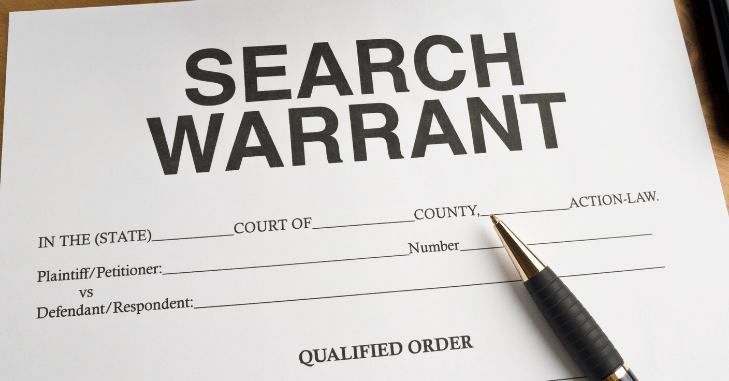
A search warrant is a written court order, signed by a judge or magistrate, that authorizes police to search a specific place for specific evidence of a crime and to seize what they find. In the United States, the Fourth Amendment requires that a warrant be based on probable cause, supported by a sworn statement, and describe with particularity the place to be searched and the things to be seized. Police must generally follow the warrant’s limits when they execute it, and evidence gathered through an invalid warrant or an unlawful search can be excluded from trial, although there are important exceptions to both the warrant requirement and the exclusion rule.
This guide explains how warrants are obtained and executed, the main types, when police can search without one, your rights during a search, and what happens if something goes wrong.
The Constitutional Basis
The Fourth Amendment protects “the right of the people to be secure in their persons, houses, papers, and effects, against unreasonable searches and seizures,” and states that “no Warrants shall issue, but upon probable cause, supported by Oath or affirmation, and particularly describing the place to be searched, and the persons or things to be seized.” It applies to state and local police through the Fourteenth Amendment. Many state constitutions contain similar, and sometimes stronger, protections.
What Makes a Search Warrant Valid
- Probable cause: a fair probability, based on the facts presented, that evidence of a crime will be found in the place to be searched. It requires more than a hunch but less than proof beyond a reasonable doubt. Courts look at the totality of the circumstances, including the reliability of any informant.
- Oath or affirmation: an officer’s sworn affidavit setting out those facts.
- Particularity: a specific description of the location (for example, a street address and unit number) and the items sought. General warrants allowing officers to rummage for anything are not allowed.
- A neutral and detached magistrate: the judge must be independent of the investigation.
- Timeliness: the information cannot be stale, and the warrant must be executed within the time allowed. In federal cases, Rule 41 of the Federal Rules of Criminal Procedure generally requires execution within 14 days and during the daytime, defined as 6:00 a.m. to 10:00 p.m., unless the judge authorizes otherwise. State time limits vary.

How Police Obtain a Search Warrant
- Investigation. Officers gather information from witnesses, surveillance, records, informants or controlled purchases.
- Affidavit. An officer writes a sworn affidavit describing the facts and what is expected to be found.
- Judicial review. A judge reviews the application, sometimes in person and often electronically. Many courts now allow warrants to be applied for and signed remotely.
- Issuance. If the judge finds probable cause, they sign a warrant describing the place, the items and any special conditions.
Types of Search Warrants
| Type | What it allows |
|---|---|
| Standard premises warrant | Search of a home, business or other location for listed items |
| Vehicle or person warrant | Search of a specific vehicle or individual |
| Digital or electronic warrant | Search of phones, computers, email or cloud accounts, often with protocols limiting what can be reviewed |
| No-knock warrant | Entry without announcing, where specific danger or destruction of evidence is shown; restricted or banned in some states |
| Anticipatory warrant | Becomes valid only when a triggering event occurs, such as delivery of a package |
| Sneak-and-peek (delayed notice) warrant | Allows a covert search with notice given later, under strict federal rules |

How a Warrant Is Executed
Knock and announce
Officers generally must knock, identify themselves and state their purpose, then wait a reasonable time before forcing entry. The Supreme Court has recognized this as part of the Fourth Amendment’s reasonableness requirement, while allowing no-knock entry where officers have reasonable suspicion that announcing would be dangerous or would allow evidence to be destroyed. Following high-profile incidents, several states and cities have banned or limited no-knock warrants.
Scope
Officers can search only where the listed items could reasonably be found. A warrant for a stolen television does not justify opening small drawers; a warrant for documents or drugs usually does. Officers may detain occupants while the search is carried out.
Inventory and copy
Under the federal rules, officers must leave a copy of the warrant and a receipt for property taken, and prepare an inventory that is returned to the court. Most states have similar requirements. Keep these documents; your lawyer will need them.

When Police Can Search Without a Warrant
Warrantless searches are presumed unreasonable, but courts recognize several exceptions:
- Consent: if a person with authority voluntarily agrees. You can refuse, and you can limit or withdraw consent.
- Search incident to arrest: officers may search the person arrested and the area within immediate reach. Vehicle searches under this exception are limited, and since Riley v. California (2014), police generally need a warrant to search the data on an arrested person’s cell phone.
- Exigent circumstances: emergencies such as hot pursuit, preventing imminent destruction of evidence, or helping someone in danger.
- Plain view: officers lawfully present may seize evidence whose criminal nature is immediately apparent.
- Automobile exception: with probable cause, police can search a vehicle and containers in it without a warrant because vehicles can be moved quickly.

Your Rights During a Search
| Right | What it means in practice |
|---|---|
| To see the warrant | You can ask to see it, and officers generally must leave a copy |
| To remain silent | You do not have to answer questions; say clearly that you are exercising this right |
| To refuse consent | If there is no warrant, you can say you do not consent to a search |
| To a lawyer | You can ask for an attorney, and questioning should stop once you do if you are in custody |
| To a receipt | You should receive an inventory of property taken |
Do not physically resist or obstruct officers, even if you believe the search is illegal. Challenges belong in court. Stay calm, observe, and later write down what happened, including officers’ names and the areas searched.
What Happens If a Warrant Is Invalid
The main remedy is the exclusionary rule, which the Supreme Court applied to the states in Mapp v. Ohio (1961). A defendant can file a motion to suppress evidence obtained through an unconstitutional search, along with evidence derived from it, often called “fruit of the poisonous tree.” Common challenges include lack of probable cause, stale information, an overly broad warrant, searches beyond its scope, and false statements in the affidavit. Under Franks v. Delaware (1978), a defendant who shows that an officer knowingly or recklessly included false statements essential to probable cause can obtain a hearing.
There are limits. Under the good-faith exception from United States v. Leon (1984), evidence is generally not suppressed when officers reasonably relied on a warrant that later turns out to be defective. The Supreme Court has also held that violations of the knock-and-announce rule alone do not require suppression. Civil lawsuits for rights violations are sometimes possible, but doctrines such as qualified immunity can make them difficult.

Search Warrants in the Digital Age
Phones and cloud accounts contain far more personal information than any filing cabinet, and the law has been adapting. In Carpenter v. United States (2018), the Supreme Court held that police generally need a warrant to obtain historical cell-site location records from a phone company. Digital warrants often authorize copying an entire device for later review, which raises questions about how far the search can go. Courts continue to address issues such as geofence warrants, which seek data about all devices in an area, and data stored on servers in other countries.
What to Do After a Search
- Keep the copy of the warrant and the inventory.
- Photograph any damage and write down your recollection promptly.
- Do not discuss the case with anyone except your lawyer.
- Contact a criminal defense attorney, particularly before any interview or court date.
Search challenges are central to many cases. In a drug case, for example, whether drug possession is charged as a felony or a misdemeanor can matter far less than whether the evidence was lawfully found at all. For more on how lawyers use these issues, see how criminal defense attorneys build a strategy for serious charges and what the accused should know before an arraignment hearing.

Frequently Asked Questions
What is a search warrant?
It is a court order signed by a judge that authorizes police to search a specific place for specific evidence of a crime, based on probable cause shown in a sworn affidavit.
How long is a search warrant valid?
It depends on the jurisdiction. Federal warrants generally must be executed within 14 days, and state limits vary, often ranging from a few days to a couple of weeks.
Do police have to show me the warrant?
You can ask to see it. Rules generally require officers to leave a copy of the warrant and a receipt for property taken, though they may not have to show it before entering.
Can police search my phone without a warrant?
Generally not. The Supreme Court held in 2014 that police usually need a warrant to search the data on a phone seized during an arrest, unless an exception such as consent or an emergency applies.
What happens if a search warrant was invalid?
Your lawyer can file a motion to suppress. If granted, the evidence and anything derived from it may be excluded, although the good-faith exception can allow some evidence to be used.
This article is general information, not legal advice. Search and seizure law varies by state, so consult a licensed criminal defense attorney about a specific situation.