


An unexpected injury can turn our lives upside down. It brings pain, medical bills, and often, lost income. When someone else’s carelessness or wrongful actions cause this harm, we often wonder what our rights are and how we can recover.
This is where personal injury law steps in.
It is a vital area of civil law designed to protect us. Its main purpose is to help injured people get fair compensation. This compensation aims to make us “whole” again, covering the losses we face.
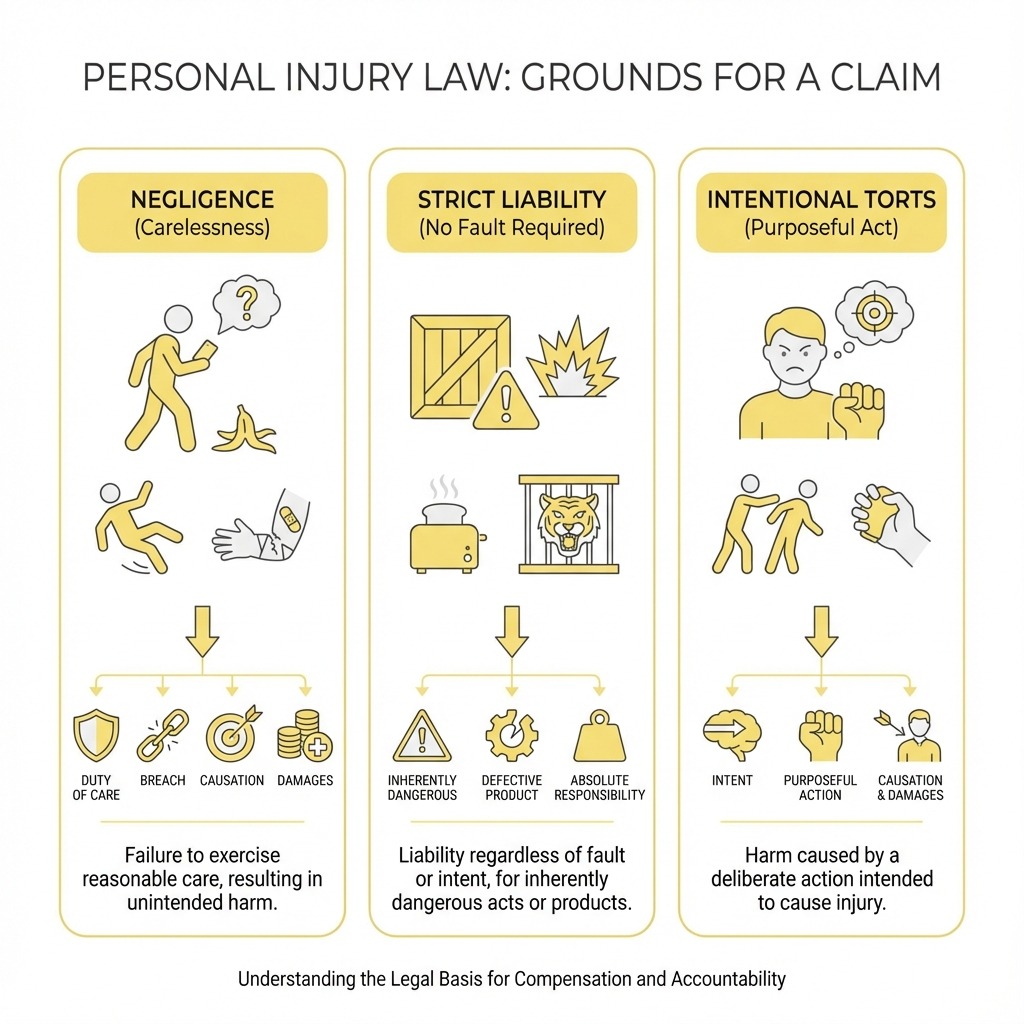
In personal injury cases, there are three main reasons, or grounds, why a claim might be made:
This extensive guide will walk us through the basics of personal injury law. We will explore how claims are made, what types of compensation are available, and the typical steps from an incident to its resolution. Our goal is to help you understand your rights and the legal process involved.
At the heart of any personal injury claim lies the concept of liability—determining who is legally responsible for the harm caused. This responsibility is often built upon several foundational legal principles: duty of care, breach of duty, causation, and damages.
Duty of Care: This is a legal obligation to act with a certain standard of care toward others. For instance, drivers have a duty to operate their vehicles safely, property owners have a duty to maintain safe premises, and medical professionals have a duty to provide competent care. The specific standard of care can vary depending on the relationship between the parties and the circumstances of the situation. It’s often judged by what a “reasonable person” would do in a similar situation.
Breach of Duty: A breach occurs when someone fails to meet their duty of care. This could be a driver running a red light, a store owner failing to clean up a spill, or a doctor misdiagnosing a condition. The breach must be a direct violation of the established duty.
Causation: After proving a breach of duty, it must be shown that this breach directly caused the injury. This involves two aspects:
- Actual Causation (Cause-in-Fact): Often determined by the “but-for” test—but for the defendant’s actions, the injury would not have occurred.
- Proximate Causation (Legal Cause): This considers whether the injury was a foreseeable result of the defendant’s actions. If an intervening event breaks the chain of foreseeability, proximate causation might not be established. For example, if a driver slightly taps another car, and then an unrelated, much larger truck crashes into the second car, the initial driver’s tap might not be the proximate cause of the severe injuries from the truck accident.
Damages: Finally, the injured party must have suffered actual harm or losses as a result of the defendant’s breach and causation. These damages can be physical, emotional, or financial, and are what the personal injury claim seeks to compensate.
Establishing Liability: Negligence, Strict Liability, and Intentional Wrongs
As introduced, personal injury claims typically fall into three broad categories based on the nature of the defendant’s conduct:
Negligence: This is the most common basis for personal injury claims. It arises when a person or entity fails to exercise reasonable care, resulting in harm to another. To prove negligence, all four elements mentioned above (duty, breach, causation, damages) must be established. Examples include car accidents caused by distracted driving, slip and falls due to unaddressed hazards, or medical malpractice.
Strict Liability: In certain situations, a party can be held liable for damages even if they were not negligent and did not intend to cause harm. This principle usually applies to cases involving:
- Defective Products: Manufacturers, distributors, and retailers can be held strictly liable for injuries caused by products that are unreasonably dangerous due to design flaws, manufacturing defects, or inadequate warnings. The injured party typically only needs to prove the product was defective and caused their injury, not that the manufacturer was careless.
- Dangerous Activities: Activities that are inherently dangerous, such as handling explosives or keeping certain wild animals, may also fall under strict liability.
- Dog Bites: In many states, dog owners are held strictly liable for injuries their dogs cause, regardless of whether the dog had a history of aggression.
Intentional Wrongs (Intentional Torts): These claims arise when a person deliberately acts in a way that causes harm. While less common in civil personal injury cases than negligence, they can lead to significant damages. Examples include:
- Assault: An intentional act that causes another person to reasonably apprehend immediate harmful or offensive contact.
- Battery: An intentional act that results in harmful or offensive contact with another person.
- False Imprisonment: Unlawfully restraining a person against their will.
- Defamation: Making false statements that harm another person’s reputation (libel for written, slander for spoken).
Proving fault in any of these categories requires careful investigation and presentation of evidence. The specific requirements can vary significantly by jurisdiction, making it crucial to understand the nuances of local laws. For those in upstate New York, for instance, understanding the nuances of Schenectady New York personal injury laws is critical for establishing liability.
Essential Concepts in Personal Injury Law
Beyond the grounds for liability, several other legal concepts significantly impact personal injury cases:
Statute of Limitations: This is a critical legal deadline. Each state sets a maximum time limit within which a lawsuit must be filed after an injury occurs. If a claim is not filed within this period, the injured party generally loses their right to seek compensation, regardless of the merits of their case. These deadlines vary widely depending on the type of injury and the state. For instance, many states have a two-year or four-year statute of limitations for general personal injury claims, but specific types of cases (like medical malpractice or claims against government entities) often have shorter or different deadlines. There can also be exceptions, such as the “findy rule,” which may extend the deadline if the injury was not immediately apparent.
Comparative Negligence: In many personal injury cases, both parties may share some degree of fault for the incident. Comparative negligence laws are designed to allocate fault and adjust compensation accordingly. Most states follow one of two main rules:
- Pure Comparative Negligence: The injured party can recover damages even if they are largely at fault, but their compensation will be reduced by their percentage of fault. For example, if you are 70% at fault for an accident and suffer $100,000 in damages, you can still recover $30,000.
- Modified Comparative Negligence: This rule limits recovery if the injured party’s fault exceeds a certain threshold (usually 50% or 51%). If your fault meets or exceeds that threshold, you may be barred from recovering any damages. If your fault is below the threshold, your compensation is reduced proportionally.
Understanding how comparative negligence applies in your state is vital, as it can significantly impact the outcome of your claim.
Duty of Care: This concept, as discussed earlier, is fundamental to negligence claims. It defines the legal obligation one party owes to another to avoid causing harm. The scope of this duty can be broad, encompassing general obligations to act reasonably, or more specific, such as a doctor’s duty to a patient or a business owner’s duty to customers.
Common Types of Personal Injury Cases and Potential Damages
Personal injury law covers a vast array of incidents where someone’s negligence or wrongful act causes harm. Understanding the common types of cases and the potential for financial recovery is key to navigating the legal landscape.
From Accidents to Malpractice: Common Causes of Action
While the specific circumstances of each case are unique, personal injury claims frequently arise from certain types of incidents:
- Car Accidents: These are among the most prevalent personal injury cases, often resulting from distracted driving, speeding, drunk driving, or other forms of driver negligence.
- Premises Liability (Slip and Fall): Property owners have a duty to maintain a safe environment for visitors. Claims arise when injuries occur due to hazardous conditions like wet floors, uneven surfaces, or inadequate lighting.
- Medical Malpractice: When healthcare professionals deviate from the accepted standard of care, causing injury or worsening a patient’s condition, it can lead to a medical malpractice claim.
- Dog Bites: Many states hold dog owners responsible for injuries inflicted by their pets, often under strict liability statutes.
- Workplace Accidents: While many workplace injuries are covered by workers’ compensation, some may also give rise to personal injury claims against third parties (e.g., a defective machine manufacturer or a negligent contractor).
- Wrongful Death: When a person dies due to the negligence or wrongful act of another, their surviving family members may file a wrongful death claim to seek compensation for their losses.
- Product Liability: Injuries caused by defective or dangerous products, ranging from faulty appliances to unsafe medications.
- Truck Accidents: Due to their size and weight, accidents involving commercial trucks often result in severe injuries and complex liability issues, potentially involving the driver, trucking company, or cargo loaders.
- Motorcycle, Bicycle, and Pedestrian Accidents: These vulnerable road users are often victims of negligent drivers, leading to serious injuries.
- Boating Accidents: Negligence on waterways, including intoxicated operation or reckless driving, can lead to severe personal injuries.
Understanding Compensation: The Types of Damages You Can Recover
The goal of a personal injury claim is to provide compensation, known as “damages,” to the injured party for their losses. These damages are typically categorized into economic and non-economic, and in some cases, punitive damages.
Economic Damages: These are quantifiable financial losses that can be precisely calculated and documented. They aim to reimburse the injured party for out-of-pocket expenses and lost income. Common examples include:
- Medical Expenses: This covers all past and future medical costs related to the injury, including emergency room visits, hospital stays, surgeries, doctor appointments, prescription medications, physical therapy, rehabilitation, medical equipment, and in-home care.
- Lost Wages: Compensation for income lost due to time missed from work because of the injury, including past and future lost earnings.
- Loss of Earning Capacity: If the injury permanently affects the ability to work or earn at the same level as before, this damage compensates for the reduction in future income potential.
- Property Damage: In cases like car accidents, this covers the cost of repairing or replacing damaged property.
- Other Out-of-Pocket Expenses: Costs such as transportation to medical appointments, necessary home modifications, or vocational retraining.
Non-Economic Damages: These damages are more subjective and compensate for intangible losses that do not have a direct monetary value but significantly impact the injured person’s quality of life.
- Pain and Suffering: This is compensation for the physical pain and emotional distress experienced as a result of the injury. This can include chronic pain, discomfort, anxiety, depression, and psychological trauma.
- Loss of Enjoyment of Life: If the injury prevents the individual from participating in hobbies, activities, or aspects of life they once enjoyed, this damage compensates for that loss.
- Disfigurement or Impairment: Compensation for permanent scarring, loss of a limb, or other physical disfigurements or impairments that affect appearance or bodily function.
- Loss of Consortium: In some cases, a spouse or family member may claim damages for the loss of companionship, affection, and support from the injured person.
Calculating these damages accurately often requires significant expertise, which is why many turn to firms with a background in Board-Certified personal injury law to ensure a fair assessment. While economic damages rely on bills and wage statements, non-economic damages often require compelling arguments based on the severity of the injury, its impact on daily life, and expert testimony.
Punitive Damages: Unlike compensatory damages (economic and non-economic), punitive damages are not intended to compensate the victim. Instead, they are awarded in rare cases to punish the defendant for particularly egregious, reckless, or malicious conduct and to deter similar behavior in the future. The specific criteria for awarding punitive damages vary significantly by state and are typically reserved for extreme circumstances.
The Journey of a Personal Injury Claim: From Incident to Resolution
Understanding the typical progression of a personal injury claim can help manage expectations and ensure crucial steps are not missed. The journey often begins immediately after an incident and can proceed through several distinct phases.
The Initial Steps: After the Injury Occurs
The actions taken immediately following an injury can profoundly affect the strength and outcome of a personal injury claim.
- Seek Immediate Medical Attention: Your health is paramount. Even if you don’t feel severely injured, some conditions, like internal bleeding or whiplash, may not be immediately apparent. Seeking prompt medical care ensures proper diagnosis and treatment. Crucially, it also creates an official record linking your injuries to the incident, which is vital evidence for your claim. Delaying medical attention can be used by insurance companies to argue that your injuries were not severe or were caused by something else.
- Document the Scene: If possible and safe to do so, gather evidence at the scene. Take photographs and videos of:
- The overall accident scene.
- Any property damage (e.g., vehicle damage, damaged items).
- Your visible injuries.
- Any hazards that caused the injury (e.g., a spill, uneven pavement).
- Relevant environmental factors (e.g., weather conditions, lighting).
- Gather Witness Information: If there are witnesses, obtain their names and contact information. Their unbiased accounts can be invaluable.
- Report the Incident:For car accidents: Call the police to file an accident report.
- For slip and falls: Report the incident to the property owner or manager and ensure an incident report is created.
- For workplace injuries: Report it to your supervisor or employer.
- For dog bites: Report it to local animal control.
- Preserve Evidence: Keep all documentation related to the incident, including medical records, bills, receipts for related expenses, police reports, and any communications with insurance companies. Avoid posting details about the incident or your injuries on social media, as these posts can be used against your claim.
Navigating the Legal Process
Once the initial steps are handled, the personal injury claim typically moves into a more formal legal process:
- Consult with a Personal Injury Lawyer: This is often the most critical step. An experienced lawyer can assess the merits of your case, explain your rights, and guide you through the complexities of the legal system. They can also handle communications with insurance companies, protecting you from common pitfalls.
- Investigation and Evidence Gathering: Your attorney will conduct a thorough investigation, gathering all necessary evidence. This may include obtaining police reports, medical records, witness statements, expert opinions (e.g., accident reconstructionists, medical experts), and surveillance footage.
- Insurance Adjusters and Settlement Negotiations: After the investigation, your attorney will typically submit a demand letter to the at-fault party’s insurance company. This letter outlines the facts of the case, the extent of your injuries, and the damages you are seeking. Insurance adjusters, who work for the insurance company, will then evaluate the claim and may make a settlement offer. Negotiations can be extensive, with multiple rounds of offers and counteroffers. Initial offers are often low, and an attorney can leverage their experience to fight for fair compensation.
- Filing a Lawsuit (Litigation): If a fair settlement cannot be reached through negotiation, your attorney may advise filing a formal lawsuit in civil court. This initiates the litigation process, where you become the “plaintiff” and the at-fault party becomes the “defendant.”
- The Findy Phase: This is a formal pre-trial process where both sides exchange information and evidence. It can involve:
- Interrogatories: Written questions that must be answered under oath.
- Requests for Production: Demands for documents, photos, videos, and other physical evidence.
- Depositions: Out-of-court sworn testimonies from parties, witnesses, and experts, recorded by a court reporter.
- Mediation or Arbitration: Before trial, many courts require or encourage alternative dispute resolution methods like mediation or arbitration.
- Mediation: A neutral third party (the mediator) facilitates discussions between the parties to help them reach a mutually agreeable settlement. The mediator does not make a decision, but helps the parties find common ground.
- Arbitration: A neutral third party (the arbitrator) hears arguments and evidence from both sides and then makes a binding or non-binding decision.
- Trial: If mediation and arbitration fail, the case proceeds to trial. A judge or jury will hear the evidence, listen to arguments from both attorneys, and then render a verdict. Trials can be lengthy and complex, but only a small percentage of personal injury cases actually go to trial, with most resolving through settlement at earlier stages.
This complex journey is where an experienced legal guide becomes invaluable. For instance, the professionals at a firm like J. Fine personal injury law steer these steps on behalf of their clients, ensuring every legal avenue is explored and protected.
Frequently Asked Questions about Personal Injury Law
Navigating the aftermath of a personal injury can raise many questions. Here, we address some of the most common inquiries.
What is the difference between a personal injury lawsuit and criminal charges?
It’s a common misconception that if an incident leads to criminal charges, a personal injury lawsuit isn’t necessary or possible. However, personal injury lawsuits and criminal charges are entirely separate legal proceedings with different purposes, burdens of proof, and outcomes.
- Purpose: Personal Injury Lawsuit (Civil Case): The primary purpose is to compensate the injured party (plaintiff) for their losses (damages) caused by the defendant’s negligence or wrongful act. It’s about financial recovery to make the victim “whole” again.
- Criminal Charges: The purpose is to punish the defendant for violating a law and to protect society. The state (prosecution) brings the charges, not the individual victim.
- Burden of Proof: Personal Injury Lawsuit: The plaintiff must prove their case by a “preponderance of the evidence,” meaning it’s more likely than not (over 50% likelihood) that the defendant is responsible for the injuries. This is a lower standard than in criminal cases.
- Criminal Charges: The prosecution must prove the defendant’s guilt “beyond a reasonable doubt,” a much higher standard reflecting the potential loss of liberty or life.
- Outcomes: Personal Injury Lawsuit: If successful, the outcome is typically monetary compensation (damages) paid to the plaintiff.
- Criminal Charges: If convicted, the outcome can include fines, imprisonment, probation, or other penalties imposed by the state.
Crucially, an incident can lead to both a criminal case and a civil personal injury lawsuit. For example, a drunk driver who causes an accident might face criminal charges for DUI (brought by the state) and a personal injury lawsuit from the injured victim (seeking compensation for medical bills, pain, etc.). The outcomes of these two cases are independent.
How much does it cost to hire a personal injury lawyer?
One of the most significant concerns for injured individuals is the cost of legal representation, especially when facing mounting medical bills and lost income. Fortunately, most personal injury lawyers operate on a contingency fee basis.
- No Upfront Costs: Under a contingency fee agreement, you do not pay any attorney fees upfront. This means you can secure legal representation without needing immediate funds.
- Lawyer’s Percentage: The lawyer’s fee is a pre-agreed percentage of the final settlement or court award. This percentage typically ranges from 25% to 40%, depending on the complexity of the case and whether it goes to trial.
- “No Win, No Fee”: If your lawyer doesn’t win your case (either through settlement or trial), you generally don’t owe them any attorney fees. This arrangement aligns the lawyer’s interests with yours, as they only get paid if you do.
- Client Responsibility for Case-Related Expenses: While attorney fees are contingent, clients are usually responsible for case-related expenses (also known as “costs” or “disbursements”). These can include filing fees, court reporter fees for depositions, expert witness fees, investigation costs, and postage. Your attorney will typically advance these costs throughout the case, and they will be reimbursed from the final settlement or award. It’s essential to discuss these terms clearly with your lawyer at the outset.
This fee structure makes quality legal representation accessible to everyone, regardless of their current financial situation, ensuring that victims can pursue justice without added financial burden.
When should I consult a personal injury lawyer?
While not every minor bump or scrape requires legal intervention, there are several situations where consulting a personal injury lawyer is particularly important and highly advisable:
- Serious or Long-Term Injuries: If your injuries are severe, require extensive medical treatment, or are likely to result in long-term disability, chronic pain, or permanent impairment, a lawyer can help ensure you receive compensation that covers all future medical costs, lost earning capacity, and significant non-economic damages.
- Disputed Fault or Complex Liability: If there’s a disagreement about who caused the accident, or if multiple parties might be at fault (e.g., a multi-vehicle accident, a construction site injury involving multiple contractors), a lawyer can investigate, gather evidence, and establish liability.
- Complex Legal Issues: Cases involving specific statutes (like product liability laws), governmental entities, or unique legal precedents often require specialized legal knowledge.
- Unfair Insurance Settlement Offers: Insurance companies are businesses, and their goal is often to minimize payouts. If an insurance adjuster offers a quick, low settlement or denies your claim, a lawyer can negotiate on your behalf, challenge unfair tactics, and fight for the full value of your claim.
- Navigating Statutes of Limitations: As discussed, strict deadlines apply to filing personal injury lawsuits. A lawyer can ensure your claim is filed within the appropriate timeframe, preventing you from losing your right to compensation.
- Significant Property Damage: Even if your physical injuries seem minor, significant property damage can indicate a severe impact, which might lead to delayed or hidden physical injuries. A lawyer can help connect these dots.
- Wrongful Death: If a loved one has died due to someone else’s negligence, a wrongful death claim is complex and emotionally challenging. A lawyer can handle the legal burden, allowing your family to grieve.
If your injury is more than a minor inconvenience, involves medical treatment beyond a single doctor’s visit, or if you feel overwhelmed by the legal or insurance process, it’s wise to seek legal counsel. Many personal injury lawyers offer free initial consultations, providing an opportunity to discuss your case and understand your options without any financial commitment.
Conclusion: Protecting Your Rights and Moving Forward
Experiencing a personal injury can be a profoundly disruptive event, affecting not only your physical health but also your emotional well-being and financial stability. However, understanding the principles of personal injury law empowers you to protect your rights and seek the justice you deserve.
We’ve explored the fundamental aspects of personal injury law, from the cornerstones of liability—negligence, strict liability, and intentional wrongs—to the crucial concepts of duty of care, causation, and statutes of limitations. We’ve also dug into the common types of personal injury cases, the distinctions between economic and non-economic damages, and the typical journey a claim takes from incident to resolution.
The importance of prompt action cannot be overstated. Seeking immediate medical attention, thoroughly documenting the scene, and consulting with an experienced personal injury attorney early in the process are all critical steps that can significantly impact the success of your claim.
Being an informed victim means recognizing when you have a valid claim, understanding the complexities of the legal process, and knowing when to seek professional guidance. While the legal landscape can seem daunting, personal injury law exists to provide a pathway for recovery, ensuring that those harmed by another’s wrongdoing can regain their footing and move forward. You don’t have to steer this challenging time alone.
If you want to know about The Advantage of Expertise: How a Personal Injury Lawyer Changes Your Case then visit our Accidents Law category.







