What Makes a Strong Retaliation Case often comes down to clear proof connecting protected activity to harmful employer action. Strong claims usually combine documents, timing, witnesses, and evidence challenging the employer’s stated reason. No single fact guarantees success because the governing law and evidence control each case.
| Key issue | What strengthens the claim |
| Protected activity | A clear complaint, report, request, charge, or participation protected by the applicable law. |
| Employer knowledge | Proof that the relevant manager or decision-maker knew about the protected activity. |
| Materially adverse action | Termination, demotion, discipline, reduced hours, harmful transfer, threats, or other deterrent conduct. |
| Causation | Close timing, retaliatory statements, shifting explanations, comparator evidence, or proven pretext. |
| Evidence quality | Contemporaneous emails, reviews, policies, witness accounts, schedules, and a dated timeline. |
| Deadlines | Prompt filing under the correct federal, state, local, or whistleblower law. |
A strong workplace retaliation claim usually shows protected activity, employer knowledge, a materially adverse action, and causation. The strongest evidence often includes written complaints, sudden treatment changes, inconsistent explanations, and credible witnesses. Timing helps, but timing alone does not automatically prove a retaliatory motive.
Key Takeaways
- Protected activity must fall under the law governing the dispute.
- The employer usually must know about the protected activity before retaliation can be inferred.
- Materially adverse conduct can include more than firing or demotion.
- Close timing is useful, but there is no universal safe or forbidden time gap.
- Pretext evidence often matters more than timing alone.
- Filing deadlines can be short and vary by statute.
What Makes a Strong Retaliation Case Under U.S. Law?
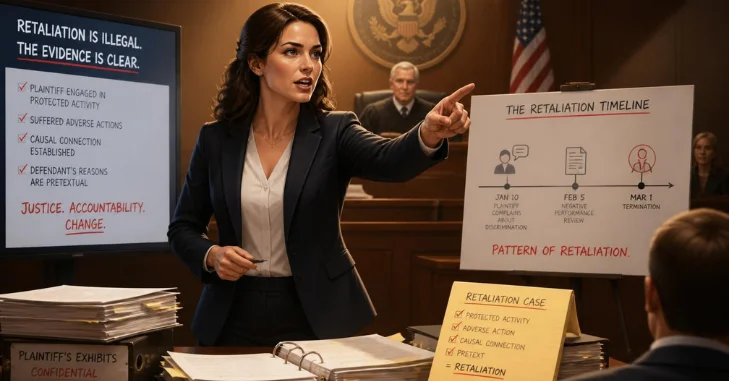
What Makes a Strong Retaliation Case depends on several factors. Most federal employment retaliation claims revolve around three core elements: protected activity, materially adverse action, and causation. Employer knowledge also matters because retaliation requires a link between the protected conduct and the response. The exact test can change under different federal or state statutes.
Under federal EEO laws, protected activity includes participating in an EEO process or reasonably opposing unlawful discrimination. The EEOC explains both forms of protected activity in its retaliation guidance. A complaint can be protected even when the underlying discrimination claim later fails.
Protected Activity Must Be Clear and Documented
A strong claim starts with conduct the law protects, not merely a general workplace disagreement. Examples include reporting discrimination, supporting another worker’s EEO complaint, or requesting a disability accommodation. Wage, safety, leave, and whistleblower laws can protect other activities under separate rules.
Written records usually make the protected activity easier to prove later. Save the complaint, email, agency charge, accommodation request, or investigation notice when legally permitted. A dated record can also show who received the complaint and what that person knew.
The Employer Must Take a Materially Adverse Action
Retaliation is broader than termination under federal EEO law. An action may qualify when it could deter a reasonable person from asserting protected rights. Context matters, so a small change in one workplace may be serious in another.
Possible examples include demotion, suspension, reduced hours, a harmful transfer, threats, or increased scrutiny. A lower evaluation can matter when it affects pay, advancement, or future opportunities. Conduct outside the workplace can also qualify when it would reasonably deter protected activity.
Causation Is Usually the Hardest Part to Prove
Causation asks whether the employer acted because of the protected activity. Close timing can support that inference, especially when treatment changes soon after management learns about a complaint. No nationwide rule makes a specific number of days automatically sufficient.
For private-sector and state or local employers, the EEOC describes a but-for standard under federal EEO laws. Retaliation need not be the only cause under that standard. The question is whether the adverse action would have occurred without the retaliatory motive.
Evidence That Can Make a Retaliation Claim Stronger
Direct evidence is useful, but most workers rely on several pieces of circumstantial evidence. A manager’s retaliatory statement can be powerful when it links the complaint to later discipline. More often, the proof appears through patterns, documents, timing, and inconsistent decision-making.
- Emails or messages acknowledging the complaint or protected request.
- Strong performance reviews before the protected activity.
- Sudden discipline, scrutiny, schedule changes, or exclusion afterward.
- Different explanations for the same adverse decision.
- Comparator evidence showing others received milder treatment for similar conduct.
- Witnesses who heard threats, criticism, or references to the complaint.
- Policies showing normal procedures were skipped or applied differently.
Pretext evidence can be especially important when the employer offers a legitimate explanation. A reason may appear weaker when records contradict it, or managers keep changing their story.Evidence that similar employees were treated differently can also help test whether the explanation is credible.
Build a Timeline Before Memories and Records Disappear
Create a dated timeline covering the period before and after the protected activity. Include complaints, meetings, performance feedback, discipline, schedule changes, and the final adverse action—note who attended each event and where supporting records may exist.
Preserve documents you may lawfully keep, including personal emails, pay records, reviews, and written notices. Do not take trade secrets or confidential material you have no right to possess. LawGaze also explains practical evidence preservation in its wrongful termination claim guide.
Employer Defenses Can Reveal Where the Case Is Weak or Strong
Employers often argue they did not know about the protected activity. They may also point to poor performance, misconduct, attendance problems, or a reduction in force. Consistent treatment of comparable workers can support the employer’s explanation.
A worker should compare those reasons with records created before the dispute. Earlier praise, missing warnings, or sudden policy changes may challenge a new performance explanation. Existing discipline that predates the complaint can also also weaken a retaliation theory.
A Simple Example of Stronger Retaliation Evidence
Assume an employee reports sex discrimination to HR and keeps the email. Two weeks later, a manager mentions the complaint and starts a new performance plan. Earlier reviews show no similar criticism, and coworkers confirm the employer ignored comparable mistakes.
Those facts do not guarantee a legal victory. They provide several independent links between the protected complaint and the later action. The claim becomes stronger if the employer’s explanation conflicts with records or changes over time.
What Can Weaken a Workplace Retaliation Claim?
- The complaint concerns ordinary unfairness without identifying conduct protected by the governing law.
- The decision-maker did not know about the protected activity.
- The employer documented serious performance or conduct problems before the complaint.
- The employer treated comparable workers the same way under the same policy.
- The timing is remote, and no other evidence connects the events.
- Records were altered, exaggerated, or collected through improper access.
A weak point does not always end the claim becauseyous mustconsider the facts together. One strong document can matter more than several vague suspicions. A lawyer can also identify protections that are easy to miss under state or local law.
Filing Deadlines Can Affect Even a Well-Supported Claim
For many EEOC claims, the filing period is 180 days from the alleged violation. That period can extend to 300 days when qualifying state or local protections apply. Federal employees generally must contact an agency EEO counselor within 45 days.
Other retaliation laws use different deadlines and procedures. OSHA says deadlines under its whistleblower statutes can range from 30 to 180 days. State laws can add separate claims, remedies, agencies, and filing periods.
What to Do If You Suspect Retaliation
- Write a factual timeline with dates, names, and specific actions.
- Preserve lawful copies of complaints, reviews, messages, schedules, and notices.
- Identify witnesses who observed the complaint or later treatment.
- Compare the employer’s stated reason with earlier records and normal procedures.
- Check the correct agency deadline before negotiating or delaying action.
- Speak with an employment lawyer who handles the relevant jurisdiction and statute.
If retaliation followed a termination, review LawGaze’s wrongful termination overview. Wage complaints may involve separate protections discussed in its employee wage claim guide. Workers facing internal accusations can also use its guide to being falsely accused at work.
Retaliation disputes can overlap with wage, discrimination, leave, safety, or whistleblower laws. LawGaze’s guide to finding the right legal professional explains why jurisdiction and issue selection matter. Early review can protect deadlines and help separate strong evidence from assumptions.
Bottom Line
A strong retaliation claim is built from legal elements and reliable evidence, not suspicion alone. The best records connect protected activity, employer knowledge, adverse action, and retaliatory causation. Prompt action also helps preserve documents, witness memories, and filing rights.
Frequently Asked Questions
What makes a strong retaliation case if there is no direct admission?
A claim can still be strong without a manager admitting retaliatory intent. Timing, pretext, comparator evidence, witness testimony, and inconsistent explanations can support a causation claim. Courts and agencies often evaluate the full record rather than a single piece of evidence.
Does timing alone prove workplace retaliation?
No universal rule makes close timing automatically prove retaliation. The EEOC recognizes suspicious timing as relevant evidence, but other facts still matter. A longer gap can also support a claim when other evidence shows continuing retaliatory motive.
Does the original discrimination complaint have to succeed?
Not always under federal EEO retaliation rules. Protected participation can remain protected even when the underlying allegation is unsuccessful or untimely. Opposition activity generally depends on a reasonable belief that unlawful discrimination occurred.
Can a negative performance review count as retaliation?
It can, depending on the circumstances and its practical effect. A materially adverse action is conduct that could deter a reasonable person from protected activity. A review tied to lost pay or advancement may carry more weight.
How quickly should someone act after suspected retaliation?
Act promptly because filing periods vary and some are short. EEOC filing deadlines commonly run 180 or 300 days, while federal employees follow a different process. OSHA whistleblower deadlines can be as short as 30 days under some statutes.