When can I apply for citizenship? For most U.S. green card holders, the answer is five years after becoming a permanent resident, with the option to file Form N-400 up to 90 days early. Eligible spouses of U.S. citizens may qualify after three years instead. But the filing date is only part of the calculation; you also need to meet physical presence, continuous residence, state or district residence, and good moral character requirements.
Understanding these rules before filing can help you choose the right date and avoid an unnecessary rejection. Most green card holders can file Form N-400 up to 90 days before their fifth anniversary as a permanent resident. Spouses of US citizens use a three-year mark instead. You also need 913 days of physical presence on the five-year path, or 548 days on the three-year path.
The Two Dates You Need to Know
Two dates. That is the whole puzzle, and most rejected applications mix them up. Your eligibility date is the day you have served the full residence period. Your earliest filing date sits 90 days before it.
| General rule (INA 316) | 5 years as a permanent resident | 90 days before the 5 year mark | 913 days (30 months) |
| Spouse of a US citizen (INA 319(a)) | 3 years as a permanent resident | 90 days before the 3-year mark | 548 days (18 months) |
| Qualifying military service (INA 328) | 1 year of service, in many cases none | Varies by provision | Often waived |
Key Takeaways
- Count from the “Resident Since” date on your green card, not from the day you arrived.
- Five years is the default. Three years applies only to spouses of US citizens.
- You may file 90 days early, but you cannot take the oath early.
- Continuous residence and physical presence are separate tests. Both can sink you.
- Trips over 180 days raise questions. Trips over 365 days break the clock outright.
- An arrest inside the window can push your date back years.
When Can I Apply for Citizenship? Where Your Five-Year Clock Starts
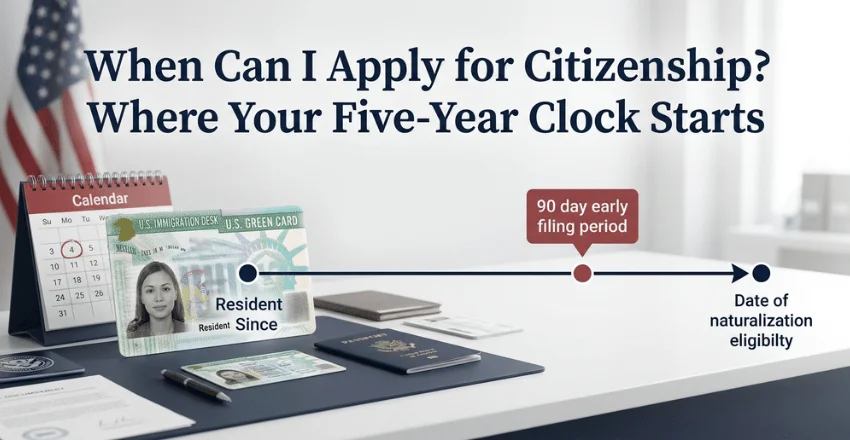
If you’re wondering when can I apply for citizenship?, the default path asks for five years of continuous residence as a permanent resident. Your start date is the “Resident Since” date on the front of your green card, not the day you landed or the day USCIS approved you.
Two groups get a pleasant surprise. If you won asylum and then adjusted status, USCIS rolls your residence date back one year. Refugees get theirs rolled back to the date of admission. Both groups are often eligible a full year early.
One more rule quietly blocks people who just moved. You must have lived in the state or USCIS district where you file for at least three months. Move in June, and you file in September at the earliest, whatever your green card says.
The Three Year Rule for Spouses of US Citizens
Marriage to a US citizen shortens the wait, but it adds conditions. You need three years of permanent residence, and your spouse must have been a citizen for those same three years. You also have to be living in marital union the entire time.
“Marital union” is stricter than “still married on paper.” A legal separation ends it. So does living apart in a way that shows the marriage has broken down. If the marriage ends before your oath, the three-year path closes and the five-year clock returns. That is one reason the drawbacks of filing for divorce first deserve a hard look.
Widowhood is different. If your citizen spouse dies before you naturalize, the three-year route closes.
The 90 Day Early Filing Window, Explained With Real Dates
Federal law lets you file before you are technically eligible, which surprises applicants who assume the anniversary is the finish line. Under INA 334(a), you may submit Form N-400 up to 90 days early. USCIS uses that head start to schedule biometrics and your interview.
Say your green card shows a residence date of March 15, 2022. Your five-year mark is March 15, 2027. Subtract 90 days, and you may file on December 15, 2026. File on December 14 and USCIS rejects it. One day early is still early.
Here is the trap. The 90-day window shortens when you can file, not when you can qualify. You still cannot naturalize until the full five years have run, and every other requirement is measured from the filing date. Frequent travelers file early, then fail on days they never had.
Continuous Residence and Physical Presence Are Not the Same Test
People treat these as one requirement. They are two, and each fails for different reasons.
Continuous residence asks whether you kept the United States as your home without a long interruption. Physical presence is a raw day count. According to the USCIS Policy Manual, Volume 12, Part D, Chapter 4, the five-year figure is 30 months, or at least 913 days. Spouses on the three-year path need 548 days.
USCIS counts generously in one respect: the day you leave and the day you return both count as days here. Everything in between does not. Take four separate three-month trips a year, and you pass continuous residence while landing under 913 days.
When Can I Apply for Citizenship After a Long Trip Abroad?
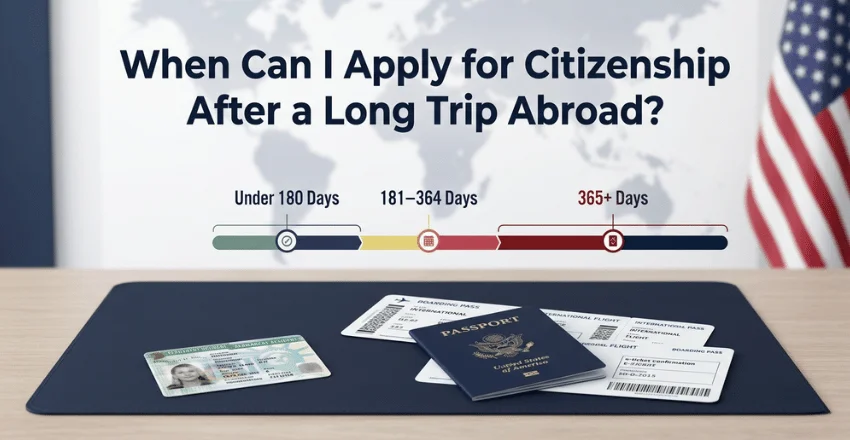
Here the answer stops being a simple anniversary. Long absences cost more than days. They can wipe the clock and start it over.
- Under 180 days. No presumption against you. The days still come off your physical presence total.
- 181 to 364 days. USCIS presumes you broke continuous residence. Rebut it with evidence: a US job you kept, family who stayed, a home you never gave up, taxes filed as a resident.
- 365 days or more. The break is automatic. Nothing rebuts it unless USCIS approved a Form N-470 before you left.
When a break is automatic, residence starts building again the day you return. On the five-year path, you may file after four years and one day. On the spouse path, it is two years and one day.
Waiting a little longer is usually smarter. Filing at four years and six months, or two years and six months, keeps the six-month presumption out of your case entirely.
Good Moral Character: The Window USCIS Actually Reviews
USCIS reviews your conduct across the same period as your residence requirement: five years back from filing, or three for spouses. Some offenses inside that window are permanent bars. Others mean waiting them out.
A conviction in year two of five years does not always end the case. It often just moves your realistic filing date out to year seven, once the offense falls behind the window. Pleas carry immigration consequences the criminal court never mentions. Speak to a criminal defense attorney who knows what a plea does to a pending immigration record.
The window is a floor, not a ceiling. Under 8 CFR 316.10(a)(2), officers may weigh older conduct when your recent record does not show reformed character. Unpaid child support, tax debt, and Selective Service gaps all surface here.
What Changed for Applicants Filing in 2026
Three changes matter right now.
Start with the civics test. Applications filed on or after October 20, 2025 use the 2025 version: 128 questions in the bank, 20 asked, 12 correct to pass. Applicants aged 65 or older with 20 years as a permanent resident get the shorter version: 10 questions from a bank of 20, 6 correct to pass.
Next, the good moral character review widened in August 2025. USCIS weighs the totality of your circumstances and expects positive attributes, not just a clean record. Neighborhood investigations are back.
Last, cost. Filing runs roughly $710 online and $760 by mail as we write this, and an increase has been proposed. Check the current USCIS fee schedule before you pay, and look at the fee waiver if your income is low.
Special Situations That Move the Date
Some routes ignore the standard calendar entirely. Service members who served during a designated period of hostilities may file with no permanent residence requirement. Spouses posted abroad for qualifying US employers can sometimes skip continuous residence under INA 319(b). Form N-470 preserves residence before a long work assignment.
Filing on the wrong date is rarely a disaster. A premature application is usually denied without prejudice, so you refile once you qualify. Denials tied to good moral character or a residence break are more serious. A few end up in removal proceedings, where outcomes vary by courtroom, so it helps to know how immigration judges are rated.
How to Count Your Own Filing Date
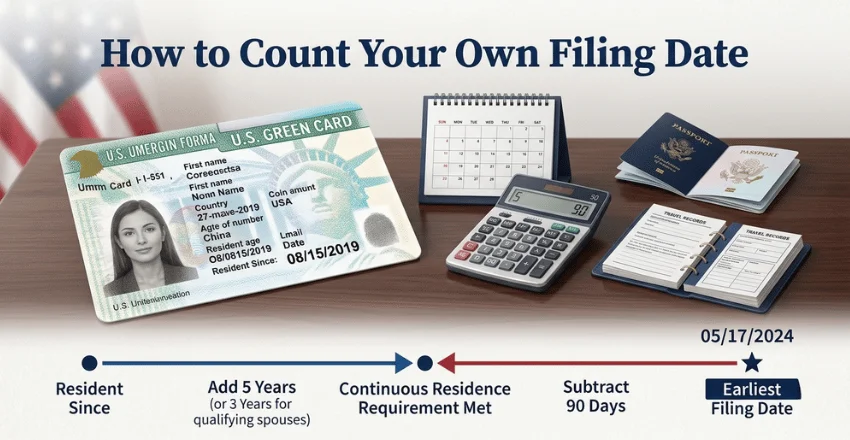
- Find the “Resident Since” date on your green card.
- Add five years, or three if you qualify as the spouse of a US citizen.
- Subtract 90 days. That result is your earliest filing date.
- List every trip abroad, with exact departure and return dates.
- Add up your days abroad and subtract them from 1,826 days, or from 1,096 on the spouse path.
- Confirm the total clears 913 days, or 548 days for spouses.
- Check that no single trip hit 180 days, let alone a year.
- Confirm three months in your current state or USCIS district.
If any step is close, gather proof before you file rather than after USCIS asks. Old passports, boarding passes, leases, and tax transcripts settle a disputed day count.
Your Next Step
Pull out your green card. Find the “Resident Since” date. Run the steps above and put your earliest filing date on a calendar. Then gather travel records, because that day count is the requirement people underestimate. Long absence, criminal charge, or a marriage that changed? Get an immigration attorney to check the math before you pay.
Frequently Asked Questions
When can I apply for citizenship if my green card came through asylum?
Your residence date rolls back one year from approval, so trust the “Resident Since” field over your approval notice. Refugees get an earlier date still.
What happens if I file too early?
USCIS rejects it, or denies it after review. You lose time and sometimes the fee. Refiling on the correct date is normal.
Does time on a conditional green card count?
Yes. A two-year conditional card counts from its start date, provided you remove the conditions. Form I-751 approval is not a new clock.
Can I travel while my application is pending?
You can, but the rules apply until you take the oath. A long trip after filing can still break continuous residence.
Does a divorce after filing hurt my three-year application?
Yes. The marital union has to survive until you naturalize. If it ends first, USCIS holds you to the five-year standard.
How long does the process take after I file?
Most cases run several months to over a year, depending on the field office. Eligibility and ceremony sit far apart, which is why filing on the first legal day helps.