Receiving a notice that says you have a court hearing can raise an immediate question: what exactly is going to happen? The court hearing meaning is simpler than the legal language may suggest, because a hearing is generally a formal proceeding in which a judge considers a particular issue in a case. It does not automatically mean that you are going to trial or that the entire case will be decided that day.
Hearings can take place in criminal, civil, family, bankruptcy, and other legal matters, and their purpose changes depending on the case. Some involve arguments between lawyers, some include testimony or other evidence, and others focus mainly on scheduling or procedural questions. Because court systems and procedures differ across the United States, the notice or order setting your hearing is the best starting point for understanding what your particular appearance involves.
Quick answer: A court hearing is a formal proceeding before a judge or other authorized decision-maker where the court considers a specific legal issue. The judge may hear arguments, review evidence, question the parties, or listen to witnesses, then issue an order or schedule the next step. A hearing is not automatically a trial.
Key Takeaways
- A court hearing is a formal proceeding used to address one or more legal issues.
- A hearing and a trial are not necessarily the same event.
- The judge may hear arguments, review documents, take testimony, or decide a procedural question.
- Common hearings include arraignments, preliminary hearings, motion hearings, evidentiary hearings, custody hearings, and sentencing hearings.
- Some hearings are conducted in person, while certain courts permit remote participation in appropriate cases.
- Missing a required appearance can have serious consequences, but the exact result depends on the court, the type of case, and applicable law.
- Always read the hearing notice and local court instructions instead of assuming that procedures are the same nationwide.
What Is a Court Hearing Meaning?
Cornell Law School’s Legal Information Institute defines a hearing as a formal proceeding before a court and notes that the term commonly describes a court session dealing with a particular question before a full trial. A federal district court glossary similarly describes a hearing as a relatively formal proceeding in which legal issues are determined. These definitions show why a hearing can be an important part of a case without necessarily resolving every issue in dispute.
In practical terms, a hearing gives the court an organized opportunity to address something that requires judicial attention. The issue might involve bail, the admissibility of evidence, a request for temporary custody, a motion asking the court to take a specific action, or another disputed matter. What the judge may decide depends on why the hearing was scheduled and what authority the court has at that stage of the case.
What Happens at a Court Hearing?
The details vary, but most hearings follow a recognizable structure. The case is called, the parties or attorneys identify themselves, and the judge turns to the issue scheduled for consideration. Each side may then have an opportunity to present its position before the court makes a ruling or determines what should happen next.
A judge may rely on written filings, oral arguments, testimony, exhibits, or a combination of those materials. Federal civil procedure, for example, allows a court deciding certain motions involving facts outside the record to consider affidavits, oral testimony, or depositions. That does not mean every hearing includes witnesses, because the evidence permitted depends on the kind of proceeding and the rules that apply.
A typical hearing may include the following stages:
| Stage | What may happen |
|---|---|
| Case is called | The judge or courtroom staff announces the case |
| Appearances | Lawyers and parties identify themselves for the record |
| Issue is identified | The court confirms what question or request is being considered |
| Arguments | Each side explains its position |
| Evidence or testimony | Documents or witnesses may be considered when appropriate |
| Questions from the judge | The judge may ask attorneys, parties, or witnesses for clarification |
| Ruling | The judge may decide immediately or issue a decision later |
| Next steps | Another hearing, filing deadline, conference, or trial may be scheduled |
Not every hearing follows every step in this table. A routine scheduling matter may require very little argument, while an evidentiary hearing can involve witnesses and disputed exhibits. The hearing notice, court rules, and instructions from the judge usually provide more specific guidance about what will be addressed.
Court Hearing vs. Trial: What Is the Difference?
A hearing and a trial are both formal court proceedings, but they usually serve different purposes. Cornell describes a trial as a proceeding in which claims are presented, evidence is examined, witnesses may be heard, and the fact-finder determines the result of a civil dispute or criminal charge. A hearing is often narrower and may address only one issue within the larger case.
| Court hearing | Trial |
|---|---|
| Often focuses on a specific issue | Generally addresses the merits of the overall dispute or charge |
| Frequently decided by a judge | May be decided by a judge or jury, depending on the case |
| Witnesses may or may not testify | Witness testimony and evidence commonly play a central role |
| Can occur at several stages of a case | Usually occurs after significant pretrial procedure |
| May result in an interim or procedural order | Can result in a verdict or final judgment on major issues |
The distinction is important because receiving a hearing notice does not by itself mean a trial is about to begin. A case can involve several hearings before trial, and many legal matters are resolved without ever reaching a full trial. The specific label on the notice and the court docket usually give more useful information than the word “hearing” alone.
Common Types of Court Hearings
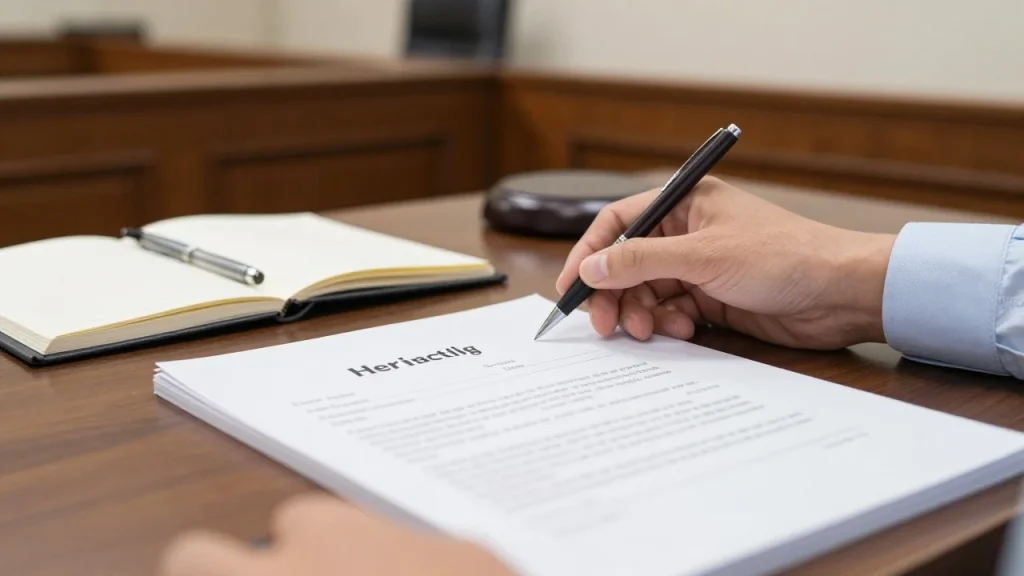
There is no single list covering every U.S. court because federal courts and the individual states use different procedures and terminology. Still, several kinds of hearings appear frequently across the legal system. Understanding their general purposes can make a court notice much easier to interpret.
Arraignment
An arraignment is an early criminal proceeding in which the accused is formally informed of the charge and asked to enter a plea. Federal Rule of Criminal Procedure 10 requires that a federal arraignment include ensuring the defendant has the indictment or information, stating or reading the substance of the charge, and asking the defendant to plead to it. State arraignment procedures can differ, so federal rules should not be treated as a universal description of every criminal case.
LawGaze’s guide to what happens at an arraignment hearing provides a practical example of how one type of criminal hearing differs from a trial. An arraignment generally focuses on the charge, plea, representation, release conditions, and procedural next steps rather than deciding guilt. Knowing which stage you are facing prevents the word “hearing” from creating the wrong expectation.
Preliminary Hearing
A preliminary hearing is used in certain criminal cases to determine whether sufficient evidence exists for the prosecution to continue. Cornell explains that the proceeding generally concerns probable cause rather than whether the defendant is ultimately guilty, and the prosecution and defense may have opportunities to question witnesses. If the required evidentiary threshold is not met, the court may dismiss the charge addressed by the proceeding, subject to the law governing that jurisdiction.
A preliminary hearing should therefore not be confused with a criminal trial. The issue at this stage is ordinarily whether there is enough evidence to move forward, not whether guilt has been proved beyond a reasonable doubt. Different states may use different names, deadlines, evidentiary rules, and procedures for comparable stages of a prosecution.
Motion Hearing
A motion is a request asking the court to issue a ruling or order, and a judge may schedule a hearing before deciding it. Motion hearings can arise in both civil and criminal cases and may concern evidence, discovery, dismissal, scheduling, temporary relief, or many other issues. Some motions are decided entirely from written filings, while others receive oral argument or evidence.
The scope of a motion hearing is normally tied to the motion itself. That is why parties should review both the hearing notice and the underlying motion rather than preparing to discuss every disagreement in the case. A narrowly focused presentation generally fits the purpose of the proceeding better than trying to relitigate unrelated matters.
Evidentiary Hearing
An evidentiary hearing focuses on facts that the court needs to resolve and can therefore involve witnesses, documents, photographs, recordings, or other admissible evidence. Witnesses may be questioned and cross-examined when the governing rules allow it. Because evidence rules and burdens of proof differ by proceeding, parties should not assume that the same material will be admissible in every hearing.
This kind of proceeding can resemble a trial more closely than a routine status or motion hearing. Even so, it may address only one factual issue rather than the entire case. The judge’s resulting decision may settle that issue while leaving the rest of the litigation unresolved.
Family Court Hearing
Family courts may hold hearings involving custody, parenting time, support, protective orders, parentage, or requests to modify an existing order. The facts a judge considers and the procedure used depend heavily on state law and the particular request before the court. Family cases are therefore a strong example of why national explanations should remain general rather than pretending one state’s rules apply everywhere.
For a more specific illustration, LawGaze explains how evidence and court appearances can arise during parentage proceedings in family court. LawGaze also discusses what can happen when someone asks a court to modify an existing family court order. Those examples show how the purpose of a hearing changes depending on what the person is asking the judge to decide.
Sentencing Hearing
A sentencing hearing takes place after a criminal conviction or guilty plea when the court determines the sentence. Depending on the case, the judge may consider statutory sentencing requirements, information about the offense, the defendant’s background, arguments from counsel, and other material the law permits. Federal criminal procedure specifically identifies sentencing as a stage at which the defendant generally must be present, although exceptions exist under the rules.
The sentencing hearing is therefore different from a hearing that determines whether a prosecution should continue. Guilt has ordinarily already been established by plea or verdict before sentencing occurs. State sentencing procedures can differ significantly from federal practice and from one another.
Who Speaks During a Court Hearing?
Who gets to speak depends on the proceeding and whether the parties have lawyers. Attorneys may present arguments and question witnesses, while a self-represented party may need to present their own position directly to the judge. The judge controls the proceeding and can ask questions, limit discussion to relevant issues, and determine when each person may speak.
Witnesses speak when testimony is required and permitted, but a party should not assume that every hearing gives everyone an unrestricted opportunity to tell their entire story. Courts commonly expect participants to address the specific issue set for hearing. Interrupting the judge or the opposing side can make the proceeding harder to follow and may violate courtroom rules.
Are Court Hearings Public?
Many court proceedings are open to the public, but public access is not absolute. The U.S. Courts website states that most federal courtroom proceedings are public, while particular rules and restrictions govern remote access, criminal proceedings, witness testimony, and other sensitive matters. State courts likewise have their own rules concerning open proceedings, confidential cases, juvenile matters, sealed records, and courtroom access.
The safest approach is to check the court’s own website or contact the clerk when you want to observe a particular hearing. Do not assume that a remote link can be shared, recorded, photographed, or rebroadcast simply because the proceeding is publicly accessible. Federal and state courts may impose specific restrictions on electronic access and recording.
Can a Court Hearing Be Held Online?
Yes, some U.S. courts conduct certain proceedings through video or telephone systems, but availability varies by court and case type. Federal judiciary policy permits forms of remote access in certain civil and bankruptcy proceedings, while criminal proceedings are subject to stricter limitations and specific procedural rules. Individual courts may also impose registration requirements, deadlines, identification rules, and restrictions on recording.
A remote hearing should be treated with the same seriousness as an appearance inside a courthouse. Follow the exact instructions in the notice, test the required technology, join early enough to resolve connection problems, and use the name or screen-name format the court requires. If the notice says the appearance is in person, do not assume you may simply join by video instead.
How Long Does a Court Hearing Take?
There is no reliable national time limit for an ordinary court hearing. A simple scheduling matter can be brief, while a contested evidentiary hearing with multiple witnesses may take considerably longer. The time written on a notice also tells you when the matter is scheduled, not necessarily the exact minute when the judge will reach your case.
Courts often place several matters on the same calendar, which can create waiting time even when an individual hearing is short. California’s court self-help materials, for example, advise participants to prepare for the possibility of spending substantial time at court even when their own matter is limited. The practical lesson is to keep enough time available rather than planning another important obligation immediately after the scheduled appearance.
What Does a Notice of Hearing Mean?
A notice of hearing generally tells you that a court has scheduled a proceeding connected to a case. It may identify the date, time, courtroom or remote-access method, case number, judge, and the motion or issue that will be considered. Reading every page matters because separate attachments can contain filing deadlines, evidence requirements, or instructions for appearing remotely.
Do not assume that all court papers carrying a date require the same response. A summons, subpoena, notice of hearing, trial notice, and jury summons serve different functions and can create different obligations. LawGaze’s jury duty guide, for example, explains why a jury summons is different from other notices associated with a court case.
What Happens If You Miss a Court Hearing?
Missing a required court appearance can create serious problems, but the consequence depends on the kind of case and the rules governing that proceeding. A court may proceed without a party, deny a request, enter an adverse order, dismiss a matter, impose a sanction, or take another action authorized by law. In some criminal contexts, failure to appear can also create consequences involving release conditions or warrants.
A New York civil-court guide illustrates how jurisdiction matters: it explains that a plaintiff who misses certain scheduled court dates may face dismissal, while a defendant may risk a default judgment. That example should not be treated as the rule for every U.S. case, because other courts may use different procedures. If you believe you cannot attend or have already missed the date, contact your lawyer or the appropriate court office promptly to learn what procedures are available.
How to Prepare for a Court Hearing
Preparation should begin with the actual documents in your case rather than a generic internet checklist. California Courts advises parties preparing for certain hearings to review their filings, organize relevant papers, prepare notes, and determine whether documents must be filed or served before the court date. Those recommendations reflect useful habits, although filing deadlines and evidence rules still depend on your own court and case type.
Before the hearing, consider these steps:
- Read the full notice, order, motion, and any attached instructions.
- Confirm whether the appearance is in person, by telephone, or by video.
- Verify the courthouse, courtroom, date, and time.
- Review deadlines for filing or exchanging evidence.
- Organize documents so you can locate them quickly.
- Prepare concise notes about the issue the judge is scheduled to decide.
- Follow local rules about copies, exhibits, witnesses, and electronic submissions.
- Request an interpreter or disability accommodation early if one is needed.
- Arrive or connect early enough to complete security, check-in, or technical setup.
- Speak respectfully, avoid interruptions, and answer the judge’s actual question.
- Ask your attorney what role you will personally have if you are represented.
Preparation does not mean memorizing a dramatic speech. Judges often need clear facts, relevant documents, and direct answers more than a long narrative about everything that has happened in the case. Staying focused on the issue identified in the hearing notice can make the presentation easier for both the participant and the court.
What Happens After the Hearing?
A judge may announce a ruling before the hearing ends, but that is not the only possible result. The court may take the issue under consideration, request additional filings, continue the matter to another date, or issue a written order later. In some proceedings, one of the parties or attorneys may also be responsible for preparing a proposed written order reflecting what the judge decided.
California’s self-help guidance for family-law hearings gives one example of this process, explaining that a judge may decide the issue that day or seek additional information and that a written order may then need to be prepared and signed. Procedures differ elsewhere, so parties should confirm whether they need to file anything after leaving the courtroom. A verbal understanding of what happened should not replace reading the signed order or docket entry when one is issued.
Do You Need a Lawyer for a Court Hearing?
Whether legal representation is required or advisable depends on the proceeding, your role, the stakes, and the applicable law. Some people represent themselves in civil or family matters, while criminal defendants may have constitutional or statutory rights to counsel in circumstances defined by law. Even when self-representation is permitted, a hearing involving liberty, custody, substantial money, complex evidence, or unfamiliar procedural rules can justify getting legal advice.
If a case crosses several legal areas, identifying the correct type of professional can be just as important as deciding whether to seek help. LawGaze’s guide to finding the right legal professional when a case involves multiple issues explains why connected problems may still be governed by different courts, deadlines, and areas of law. Court clerks can generally provide procedural information, but they cannot act as your lawyer or give case-specific legal strategy.
Frequently Asked Questions
Does a Court Hearing Mean I Am Going to Trial?
No, a hearing does not automatically mean the case is going to trial that day. Hearings commonly address narrower issues such as motions, scheduling, release conditions, evidence, temporary orders, or probable cause. A trial is usually a more comprehensive proceeding addressing the merits of the case.
Does Everyone Have to Speak at a Court Hearing?
No, not everyone present will necessarily speak. Lawyers may handle most of the argument when parties are represented, while witnesses speak only if testimony is part of the proceeding. A judge can also decide some issues mainly from written filings and may ask questions only when clarification is needed.
Will the Judge Decide the Case at the Hearing?
Sometimes, but the result depends on what the hearing is intended to decide. A judge may resolve a particular motion or temporary issue while leaving the rest of the case pending. The judge may also postpone a ruling or issue a written decision after reviewing the matter further.
Can I Bring Evidence to a Court Hearing?
Evidence may be permitted or required, but simply bringing documents to the courthouse does not guarantee that the judge can consider them. Courts can have rules about filing, service on the opposing party, authentication, admissibility, copies, and deadlines. Review the instructions for your exact hearing before assuming that a photograph, message, record, or other document can be introduced on the spot.
Can I Attend My Hearing by Zoom or Phone?
Possibly, because many courts use remote technology for selected proceedings. Whether you may appear remotely depends on the court, the type of hearing, the judge’s instructions, and sometimes advance registration or permission. Follow the hearing notice instead of assuming that remote participation is available merely because the court uses videoconferencing in other cases.
Is a Hearing the Same as an Arraignment?
An arraignment is one particular type of criminal court proceeding, while “hearing” is the broader term. In federal court, an arraignment includes informing the defendant of the charge and asking for a plea under Rule 10. Other hearings can deal with completely different subjects, including motions, evidence, custody, sentencing, or procedural matters.
The Bottom Line on Court Hearing Meaning
The simplest court hearing meaning is a formal proceeding in which a court addresses a legal issue. The hearing may be short or lengthy, may or may not involve evidence or witnesses, and may produce an immediate ruling or only move the case to its next stage. What matters most is the purpose stated in your notice and the rules of the court handling the case.
If you have received a hearing notice, read the entire document before deciding what the appearance means for you. Confirm what issue will be heard, how you must appear, what deadlines apply, and whether documents or witnesses must be prepared in advance. When the consequences are significant or the instructions are unclear, legal advice from a lawyer familiar with the relevant jurisdiction can help you understand your options.