The good faith exception is an important legal doctrine in criminal procedure that allows courts to admit evidence collected by law enforcement officers even if the search warrant or procedure used is later found to be invalid, provided the officers acted with an honest and reasonable belief that their actions were lawful.
It serves as an exception to the exclusionary rule, which normally prevents illegally obtained evidence from being used in court. This doctrine originated in the needs. By emphasizing police intent and reasonableness, the good-faith exception ensures that justice is not undermined by minor technical errors while still maintaining fairness, the reliability of evidence, and respect for constitutional rights.
| Aspect | Overview |
| Definition | Allows admission of evidence collected in honest belief of legality. |
| Origin | Developed from the exclusionary rule, established in United States v. Leon (1984). |
| Purpose | Ensures fairness, prevents exclusion of reliable evidence, and supports efficient justice. |
| Key Principle | Focuses on officers’ good faith and reasonable belief. |
| Conditions | Valid only when officers act honestly, reasonably, and rely on a warrant. |
| Exceptions Not Applied When | Bad faith, false information, or a clearly defective warrant. |
| Limitations | Does not apply to unlawful searches or constitutional violations. |
| Impact | Reduces the exclusion of evidence and increases flexibility in criminal trials. |
| Importance | Balances justice, efficiency, and constitutional protection. |
| Criticism | May weaken strict constitutional safeguards and accountability. |
Good Faith Exception

The good-faith exception is a legal doctrine in criminal procedure that allows courts to admit evidence obtained by law enforcement officers, even if it is later found that the search warrant or procedure used to obtain it was invalid, provided the officers acted with an honest and reasonable belief that they were following the law. It serves as an exception to the exclusionary rule, which normally prevents illegally obtained evidence from being used in court.
The main idea behind this doctrine is that evidence should not be excluded when police officers make unintentional or technical errors while acting in good faith reliance on a warrant issued by a judge or on existing legal authority. However, the exception does not apply if officers act in bad faith, knowingly provide false information, or rely on a clearly defective warrant.
Legal Background and Origin of the Good Faith Exception
- The good-faith exception originated in the broader exclusionary rule.
- The exclusionary rule was developed to protect constitutional rights, especially the Fourth Amendment, against unreasonable searches and seizures.
- Traditionally, illegally obtained evidence was automatically excluded from trial to discourage police misconduct.
- However, courts later realized that strict application of this rule could sometimes lead to unfair outcomes.
- This was especially true when law enforcement officers acted without malicious intent.
- The landmark case establishing the good faith exception is United States v. Leon (1984).
- In this case, the U.S. Supreme Court ruled that evidence obtained with a defective search warrant could still be admitted.
- This was allowed if police officers acted in good faith, in reliance on that warrant.
- The decision marked a major shift in criminal procedure law.
- It emphasized police intent rather than the warrant’s legality.
- Over time, the doctrine was expanded through additional cases.
- These cases helped refine the scope and limitations of the good faith exception.
Purpose of the Good Faith Exception
The primary purpose of the good faith exception is to ensure fairness in the justice system by preventing the exclusion of reliable evidence when law enforcement officers act honestly and reasonably. It aims to balance two important goals: protecting constitutional rights and ensuring that guilty individuals do not escape punishment due to technical errors.
Another key purpose is to reduce unnecessary burden on the courts. If every minor procedural error led to exclusion of evidence, many cases could collapse even when there is strong proof of guilt. The good-faith exception helps maintain the efficiency of the judicial process.
Additionally, the doctrine encourages reasonable policing by recognizing that officers may sometimes rely on warrants or legal procedures that appear valid at the time. It prevents law enforcement officers from being punished for honest mistakes made without negligence or bad intent.
Conditions for Applying the Good Faith Exception
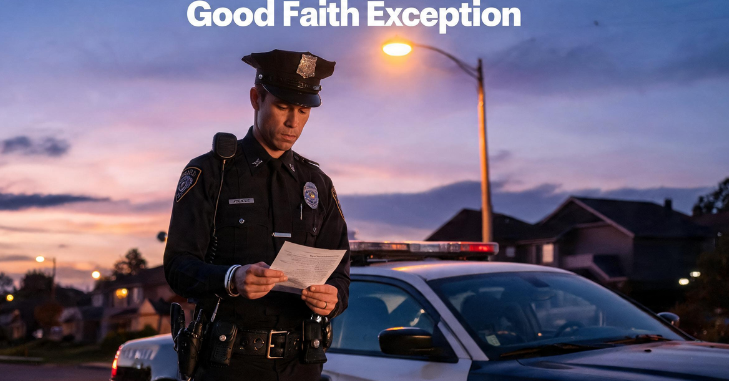
The good faith exception does not apply in every case. Courts apply it only under specific conditions to prevent misuse. One important condition is that law enforcement officers must have acted with an honest and reasonable belief that their actions were legal.
Reliance on an Invalid Search Warrant
If a search warrant is later found to be invalid, the evidence may still be admissible if the officer relied on it in good faith. However, if the warrant was issued based on false information knowingly provided by the police, the exception does not apply.
Clearly Defective Warrants
Another condition is that the warrant must not be so clearly defective that a reasonable officer should have recognized its invalidity. If the warrant is obviously flawed, officers cannot claim good faith.
Judicial Misconduct or Bad Faith Actions
The exception also does not apply if the judge who issued the warrant was misled or abandoned their neutral role. Similarly, if officers act in bad faith or deliberately violate constitutional rights, the evidence will be excluded.
Limitations of the Good Faith Exception
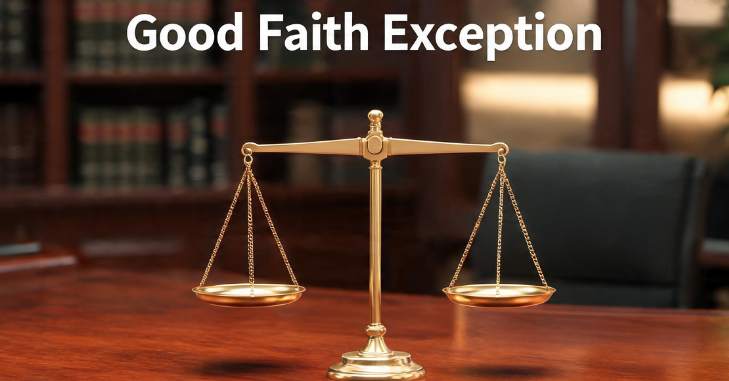
Although the good faith exception is widely used, it has clear limitations. It cannot be used to justify illegal searches conducted without any warrant or probable cause. It also does not apply when officers deliberately violate constitutional rights. If law enforcement officers act recklessly or negligently in obtaining a warrant, the exception will not protect them.
Courts carefully examine officers’ behavior to determine whether their actions were in good faith. Another limitation is that the doctrine cannot override fundamental constitutional protections. Evidence obtained through extreme misconduct or bad faith actions is always excluded to preserve justice and fairness.
Impact on Criminal Procedure and Evidence Law
- The good-faith exception has significantly affected criminal procedure by altering how courts handle illegally obtained evidence.
- It has reduced the number of cases where evidence is excluded due to minor technical errors.
- The doctrine has strengthened cooperation between law enforcement and the judiciary.
- It emphasizes reasonable reliance on judicial decisions and warrants issued by courts.
- However, it has also sparked debate about whether it weakens constitutional protections.
- In practice, the good faith exception has made criminal trials more flexible.
- It still maintains a focus on fairness and the reliability of evidence.
Importance in Modern Legal Systems
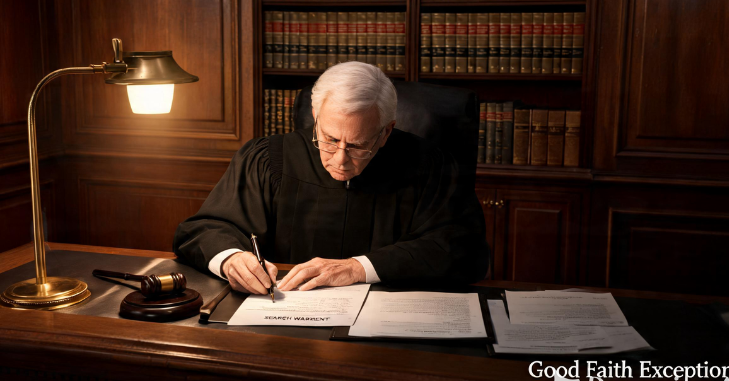
Despite criticism, the good faith exception remains an important part of modern criminal justice systems. It helps ensure that justice is not defeated by minor procedural mistakes while still respecting constitutional rights. It provides a balanced approach between strict legal rules and practical law enforcement needs. Allowing courts to consider intent and reasonableness promotes fairness in criminal trials. The doctrine continues to evolve as courts refine its application in different legal contexts.
Conclusion
The good-faith exception is a vital legal principle that allows courts to admit evidence obtained by law enforcement officers acting in good faith and with a reasonable belief that their actions were lawful. Originating from landmark judicial decisions, it serves as an exception to the exclusionary rule and plays a key role in modern criminal procedure.
While it ensures efficiency and fairness in the justice system, it also raises important concerns regarding constitutional protections and police accountability. Ultimately, the good-faith exception strikes a balance between protecting individual rights and ensuring justice is served fairly in criminal cases.
Want to know about When Defending Your Home Leads to a Criminal Investigation Check out our Criminal Law category.
FAQs
The most substantial obstacle for defendants is the good faith exception, which directs courts to admit unlawfully collected evidence if the police can show they relied in good faith on existing authority.
Acting in “good faith” means behaving honestly, fairly, and sincerely, without the intent to deceive, defraud, or take unfair advantage of others. It is the foundation of both everyday trust and formal legal agreements.
Insurer’s Conduct: If the insurer engages in any form of fraud or dishonesty, for example, misrepresentation regarding coverage or unfair claims handling, the insured may have good grounds to dispute the validity of the contract, not being bound by utmost good faith.
Good faith is the foundational legal and ethical duty to act honestly, fairly, and sincerely in all dealings. It ensures that parties honor the spirit of an agreement rather than just the literal words.