A demurrer challenges whether a complaint states a legally valid claim, assuming its alleged facts are true. It focuses on legal sufficiency, grounds, deadlines, possible rulings, and what happens next. Understanding the process can help parties respond strategically before a case moves forward.
You get served with a complaint, read it twice, and the legal theory still makes no sense. That is what a demurrer is built for. It tells the judge that even if every fact in the complaint is true, the plaintiff still has no claim. Below you get the grounds, the deadlines, the three rulings a judge can hand down, and what a win actually buys.
The Short Answer
Defendants file this motion to attack the legal sufficiency of a pleading, not the truth of its facts. Judges treat every allegation as true, then ask one question: does this state a claim the law recognizes? If the answer is no, the challenged counts fall away, and the plaintiff has to fix them or lose them.
| What it attacks | The legal sufficiency of a pleading, never the evidence behind it |
| Who files a demurrer | Usually the defendant, sometimes a plaintiff facing a cross-complaint |
| California deadline | 30 days after service, plus an automatic 30-day extension by declaration |
| Governing statute | Code of Civil Procedure sections 430.10, 430.30 and 430.41 |
| Possible rulings | Overruled, sustained with leave to amend, or sustained without leave |
| Court fee | Roughly $60 for the motion itself in California superior courts |
Key Takeaways
- This motion attacks the law inside a pleading, never the evidence behind it.
- California lists eight grounds in Code of Civil Procedure section 430.10.
- You get 30 days after service, and a short declaration buys another 30.
- Most wins come with leave to amend, so the lawsuit usually keeps going.
- California and Virginia keep the old name. Most states call the same motion a motion to dismiss.
- Court fees are small. Attorney hours are the real price.
What a Demurrer Actually Argues
Every lawsuit rests on two layers: what happened, and whether the law cares. A demurrer touches only the second layer. You are not saying the plaintiff lied; you are saying the story, taken at face value, does not add up to a legal wrong.
That limit cuts both ways. No judge can look at your emails, your signed contract, or a declaration from your bookkeeper. Rulings come from the four corners of the complaint plus anything the court may judicially notice, such as a recorded deed or an earlier order. Facts outside the pleading belong to a summary judgment motion months later, which is why commercial litigation basics deserve a read before you choose your opening move.
Attorneys split these challenges into two families. General ones say the claim fails no matter how generously you read it. Special ones say the pleading reads as too vague to answer, or that the caption names the wrong parties. Judges shrug at the second family, since California courts brush past vagueness whenever the defendant clearly understands the case.
The Eight Grounds Under Section 430.10
You cannot invent reasons. Section 430.10 sets out a closed list, and your motion has to tie a listed ground to a specific cause of action.
- No jurisdiction over the subject of the cause of action.
- Whoever sued lacks the legal capacity to sue.
- Another action is already pending between the same parties on the same cause.
- Parties are missing, or the wrong ones appear, which counts as a defect or misjoinder.
- Alleged facts are not sufficient to constitute a cause of action.
- Uncertainty, meaning a pleading that reads as ambiguous or unintelligible.
- In a contract case, the pleading never says whether the contract was written, oral, or implied by conduct.
- Someone left out a certificate required by section 411.35.
Two of these carry almost all the traffic. Ground five, the failure to state sufficient facts, is the workhorse. Uncertainty is the runner-up, and it wins far less often.
Deadlines That Decide the Case
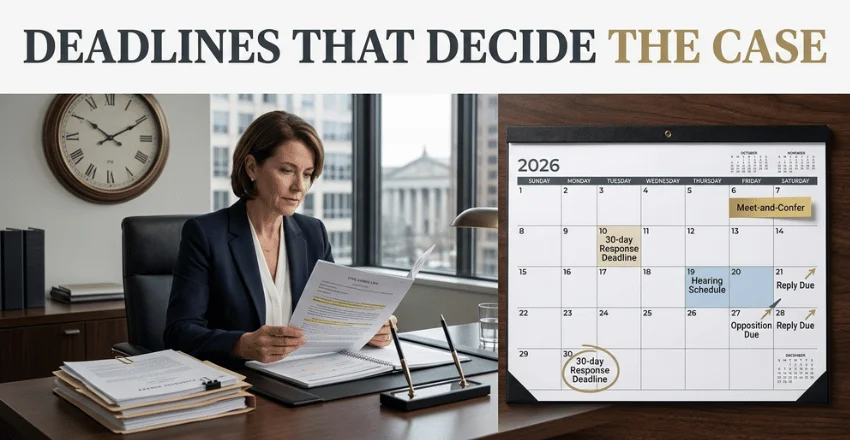
Miss the response date and the plaintiff can take your default. Here the calendar matters more than the argument.
- Day 0: the process server delivers the summons and complaint.
- At least 5 days before the response is due: meet and confer with opposing counsel in person, by phone, or by video, as section 430.41 requires.
- Day 30: your responsive pleading falls due.
- Day 30, alternative: file a declaration of a good faith attempt to meet and confer and gain an automatic 30-day extension.
- Within 35 days of filing: the clerk sets your hearing, or the first open date.
- 9 court days before the hearing: the opposition falls due.
- 5 court days before the hearing: the reply falls due.
- 10 days after the ruling: the losing side amends or answers, unless the judge orders otherwise.
Each ground goes in its own numbered paragraph, and a supporting memorandum carries the actual argument. If you have never drafted one, study how a legal brief is built and work backward from the hearing date.
Sustained, Overruled, or Sustained Without Leave
- Overruled. Your argument did not land. You then have 10 days to answer, and the case moves into discovery with your best procedural card already spent.
- Sustained with leave to amend. Your argument landed, but the plaintiff gets roughly 10 days to fix the pleading. This is the common result, and it is why a win here rarely ends anything.
- Sustained without leave to amend. Nothing can repair the claim, in the judge’s view. Those counts die, and if they were the whole case, a judgment of dismissal follows.
Section 430.41 also caps the repair work. Plaintiffs cannot amend more than three times in response to a sustained challenge, unless they show a reasonable possibility of curing the defect. Few explainers mention that ceiling.
How Often These Motions Work
No agency publishes a scorecard for California state courts, so the closest hard measure sits on the federal side. In March 2011, the Federal Judicial Center reported on exactly this question for the Judicial Conference Advisory Committee on Civil Rules. District judges granted all or part of 75.0% of Rule 12(b)(6) motions in 2010, up from 65.9% in 2006. Over the same period, the share granted with leave to amend climbed from 21% to 35%.
Read that second number twice. Most of the rise came from rulings letting the plaintiff try again, not from outright dismissals. Winning usually buys you a better complaint to fight.
How It Differs From a Federal Motion to Dismiss
| Governing rule | Code of Civil Procedure section 430.10 | Federal Rule of Civil Procedure 12(b)(6) |
| Time to respond after service | 30 days | 21 days |
| Meet and confer | Required by statute | Only where a local rule says so |
| Usual result of a win | Sustained with leave to amend | Dismissed without prejudice |
| Repeat attempts | Limited by section 430.41 | Limited by the scheduling order |
Pleading standards differ too. Federal judges apply the plausibility test from Twombly and Iqbal. California still uses fact pleading and reads a complaint more forgivingly, so an argument that lands in one courthouse can fall flat across the street.
Where the Term Still Survives
Most states retired the word during the twentieth century, when they copied the federal rules—only a handful held on. California and Virginia still file a demurrer by name, and Pennsylvania keeps the idea alive inside preliminary objections. Everywhere else, you file a motion to dismiss and argue the identical point.
Old opinions still use the word freely. Want the formal definition? Look at the entry in Black’s Law Dictionary, which traces it to the common law pleading system. Back then, a party could attack the shape of a pleading before anyone argued facts.
What It Costs, in Money and in Leverage

Court fees are the cheap part. In California superior courts, the motion fee runs around $60 once you have appeared, and it folds into your first appearance fee when you file it as your first paper.
Attorney time carries the real number. One clean ground against a tidy complaint might take eight to twelve hours of research, drafting, and argument. Ten causes of action can double that, and the reply brief adds more.
There is a quieter price nobody quotes. Your motion is a written map of every weakness you found, and the plaintiff studies it before amending. Good litigation attorneys weigh that trade out loud with clients, because an answer plus early discovery sometimes beats teaching your opponent how to plead around you.
If One Lands on Your Complaint
Plaintiffs get options too, and panic is not one of them.
- Read the meet-and-confer letter closely. It previews every argument coming at you.
- Consider amending once as of right under section 472 before the hearing, which moots the motion.
- File your opposition at least nine court days before the hearing, and answer each ground separately.
- Ask for leave to amend in the alternative, and say in one sentence what you would add.
- Check the tentative ruling the afternoon before, then decide whether arguing helps you.
Your Next Step
Pull the complaint and mark the service date on a calendar. Count 30 days forward, then set a second reminder at day 20. Read each cause of action against section 430.10 and ask whether the alleged facts, treated as true, describe a wrong the law recognizes.
If two or more counts fail that test, the hours are worth spending. If only one does, answering and pushing into discovery may serve you better. Decide by day 25, and bring the complaint to an attorney who tries civil cases in that county.
Frequently Asked Questions
They do the same job under different names. California and Virginia keep the older label, while federal judges and most state courts hear a Rule 12(b)(6) motion instead. Because the standards differ, the papers are not interchangeable.
No. An order overruling or sustaining the motion is not appealable on its own. You wait for the final judgment and raise the issue then. Dismissal after a ruling without leave to amend does open that door.
Section 430.41 caps it at three amendments in response to a sustained challenge, unless the plaintiff convinces the judge that a further fix is realistic.
No. Judges read the pleading and anything subject to judicial notice, such as a recorded deed or a prior order. Save your declarations and exhibits for summary judgment.
Opposing counsel asks the clerk for your default, and the case can end without anyone testing the merits. Calendar the response date on the day you get served.