To dismiss with prejudice means a court ends a lawsuit permanently: the plaintiff cannot refile the same claim against the same defendant. The order is treated as a final decision on the merits, so it triggers res judicata and can be appealed as a final judgment. The most common reason is a settlement, but it also follows serious misconduct, repeated failure to move the case forward, an expired statute of limitations, or a plaintiff voluntarily dropping the same claim for a second time. A dismissal without prejudice, by contrast, closes the case for now but leaves the plaintiff free to fix the problem and sue again.
The word “prejudice” comes from an older legal sense meaning harm to a right. A ruling made with prejudice harms the plaintiff’s right to sue again; one made without prejudice leaves it intact.
| Question | Short answer |
|---|---|
| Can the plaintiff sue again? | No, not on the same claim against the same party |
| Is it a ruling on the merits? | Yes, and involuntary dismissals are treated that way by default under Federal Rule of Civil Procedure 41(b) |
| Who can bring it about? | The plaintiff, the defendant, or the judge acting on the court’s own motion |
| Most common trigger | A settlement both sides want locked in |
| Deadline to appeal | Generally 30 days in federal civil cases (60 if the United States is a party); state deadlines vary |
| Criminal cases? | Yes; the prosecution cannot refile the same charge |
With prejudice vs. without prejudice
| Feature | With prejudice | Without prejudice |
|---|---|---|
| Refiling the same claim | Barred | Allowed |
| Legal effect | Adjudication on the merits | No decision on the merits |
| Res judicata | Applies | Does not apply |
| Typical causes | Settlement, sanctions, failure to prosecute, time-barred claim | Curable pleading defect, lack of jurisdiction, wrong venue, first voluntary withdrawal |
| Pressure on the plaintiff | None; the case is closed | High; the limitations period generally keeps running |
| Appeal | Available, as a final judgment | Often limited, because nothing final has been decided |
Notice the trap in the “without prejudice” column. Permission to refile is worthless if the statute of limitations expired while the first case sat on the docket. Some states have “savings statutes” that give a short grace period to refile after certain dismissals, but they are not universal, so never assume one applies.
Do not confuse either outcome with a mistrial. A mistrial ends a trial without resolving the case, and the parties can usually start again, as our explainer on how mistrials work in practice lays out.
Who can ask the court to end a case for good?

- The plaintiff. A plaintiff who has settled, run out of money or lost faith in the claim may withdraw it and agree the withdrawal is final. Defendants usually insist on that before paying a settlement.
- The defendant. A motion may argue that the plaintiff missed a deadline, defied court orders or has a claim that cannot be fixed. The judge decides whether the defect is curable.
- The court itself. Judges manage their calendars and can close a case that has gone quiet, usually after a warning or an order to show cause.
Grounds that make a dismissal permanent
Settlement
The everyday reason. The parties resolve the dispute privately and file a stipulation asking the court to dismiss with prejudice, because the defendant is paying to end its exposure for good. Settlement agreements often let the court keep jurisdiction to enforce the deal, which is worth asking for. Anyone who reaches this stage should also look at taxes on settlement money before spending it.
Sanctions for misconduct
Terminating sanctions are rare and reserved for serious abuse: destroying evidence, lying under oath, hiding documents or ignoring repeated orders. Courts generally consider lesser sanctions first. Discovery is where most of this conduct surfaces, which is one reason aggressive tactics attorneys use in depositions draw so much judicial attention.
Failure to prosecute
A plaintiff must move the case forward. Missing status conferences, ignoring discovery and letting months pass all signal abandonment. Judges normally warn first, so this outcome rarely arrives without notice.
An expired statute of limitations
A missed filing deadline cannot be cured, so there is no point inviting a second attempt. Courts close these claims permanently.
A claim that cannot be fixed by amendment
When a complaint fails to state a claim (a Rule 12(b)(6) motion in federal court), judges often allow the plaintiff to amend. If amendment would be futile, or the plaintiff has already had several chances, the dismissal is usually with prejudice.
Rule 41 and the two-dismissal trap
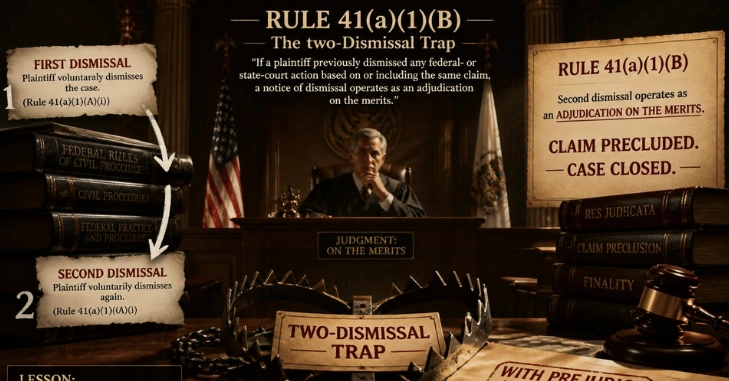
Federal practice contains a quiet trap for plaintiffs who like to reset. The Administrative Office of the U.S. Courts publishes the Federal Rules of Civil Procedure, including the edition dated December 1, 2024. Under Rule 41(a)(1)(A), a plaintiff can usually dismiss by simple notice before the defendant serves an answer or a motion for summary judgment, and that first dismissal is normally without prejudice. But Rule 41(a)(1)(B) says a notice of dismissal “operates as an adjudication on the merits” if the plaintiff previously dismissed any federal or state court action based on or including the same claim. The second notice ends the claim permanently, with no motion or hearing needed.
After the defendant has answered, a plaintiff who wants out without the defendant’s agreement needs a court order under Rule 41(a)(2), and the judge can attach conditions, such as paying the defendant’s costs. Rule 41(b) covers involuntary dismissals and makes them adjudications on the merits by default, with three exceptions: lack of jurisdiction, improper venue and failure to join a required party under Rule 19. Those leave the courthouse door open.
State rules often mirror Rule 41, but not always. Some states allow more voluntary dismissals, and deadlines differ, so check the local rules of the court where the case is pending.
Res judicata: the doctrine doing the real work
The order itself is paperwork. What actually blocks a second lawsuit is res judicata (claim preclusion), Latin for “a matter already judged”. A defendant sued again raises it as a defense. It generally requires a final judgment on the merits, the same parties or those in privity with them, and a claim arising from the same transaction or occurrence. If one element is missing, the bar may not apply: a person whose contract claim was dismissed can still sue the same defendant over an unrelated car crash.
“Adjudication on the merits” is also narrower than it sounds. In Semtek International v. Lockheed Martin (2001), the Supreme Court held that the phrase in Rule 41(b) does not by itself dictate whether a state court must treat the claim as barred; the preclusive effect of a federal diversity judgment is generally governed by the law of the state where the federal court sits.
Can you appeal an order to dismiss with prejudice?

Yes, in principle. It is a final judgment, which is exactly what appellate courts review. In federal civil cases, the notice of appeal is generally due within 30 days of entry of judgment. State deadlines vary and can be shorter. Two realities narrow the path: appellate courts review legal errors rather than reweighing evidence, and a party who agreed to the dismissal generally cannot appeal it.
Rule 60(b) is a separate route for extraordinary situations, such as newly discovered evidence, fraud by the other side, excusable neglect or a void judgment. Most grounds must be raised within a reasonable time and some within one year. These motions go to the same judge and succeed only occasionally.
What happens to counterclaims?
Ending the plaintiff’s claim does not automatically end the defendant’s. A counterclaim that can stand on its own survives. Anyone negotiating a walk-away should make sure the stipulation dismisses all claims and counterclaims, and addresses who bears their own fees and costs.
Criminal cases work differently

Criminal charges can also be dismissed with prejudice, but the authority comes from speedy trial violations, serious government misconduct and double jeopardy rather than res judicata. The result is similar: the prosecution cannot refile that charge. It is not a finding of innocence, and the arrest may still appear on your record until you seek expungement or sealing under state law. A dismissal without prejudice, by contrast, lets prosecutors refile within the limitations period.
What to do if your case was dismissed
- Read the order carefully. The key words are usually in the final paragraph. Check whether it covers every claim and every party, or only some.
- Calendar the appeal deadline from the date the judgment was entered, not the date you learned about it.
- If it was without prejudice, check how much time remains on the statute of limitations and whether any savings statute helps.
- If you settled, confirm that payment terms are enforceable and that counterclaims are also dismissed.
- Get advice quickly if money or your record is at stake. Talk to a litigation attorney sooner rather than later, because appellate deadlines are unforgiving. For how hearings on these motions run, see our guide to what happens at a court hearing.
Frequently asked questions
Does “dismissed with prejudice” mean the defendant won?
In practical terms, yes: the claim is gone and cannot return. It is not a declaration of innocence, and each side may still bear its own legal fees.
Can a judge dismiss with prejudice on their own?
Yes. Courts can close an abandoned case or sanction a party that repeatedly defies orders, usually after giving a warning.
Can a case dismissed with prejudice ever be reopened?
Only through a timely appeal or a motion under Rule 60(b) or its state equivalent, for reasons such as fraud, a void judgment or genuinely new evidence. Regret is not enough.
Does a dismissal with prejudice clear my record?
No. Court files and arrest records stay visible unless you separately petition for expungement or sealing under your state’s rules.
Is dismissal without prejudice always better for the plaintiff?
Not always. It only helps while the statute of limitations still has time left, and the defendant remains free to fight the claim again.
This article is general information, not legal advice. Rules differ between federal and state courts, so consult a licensed attorney about your case.