A new car that keeps going back to the dealer is a money problem before it is a legal one. Lemon laws exist for that situation. All 50 states and the District of Columbia have one, and no two are written the same way.
The parts that decide your case are numeric. How many failed repairs, how many days off the road, how long you have to speak up. Get those numbers wrong for your state and a strong claim quietly expires.
Short answer: a lemon law forces a manufacturer to buy back or replace a vehicle it cannot fix under warranty. Each state sets its own test. California uses four failed repair attempts, or two for a safety defect, or 30 days in the shop, inside 18 months or 18,000 miles.
State rules at a glance
These four states cover a large share of US car buyers, and they show how far the thresholds move across state lines. Every figure below comes from the state agency that administers the claim.
| State | Coverage window | Failed repairs needed | Days out of service | The step people miss |
|---|---|---|---|---|
| California | 18 months or 18,000 miles | 4, or 2 if the defect could cause death or serious injury | More than 30 | Written demand to the manufacturer at least 30 days before you sue |
| Texas | 24 months or 24,000 miles | 4 for the same defect, or 2 for a serious safety hazard | 30 or more | File within six months of the earliest trigger, $35 fee |
| Florida | 24 months from delivery | 3, plus one final attempt | 30 or more, 60 for RVs | Notice by registered or express mail before that final attempt |
| New York | 2 years or 18,000 miles | 4 | 30 or more calendar days | Mileage is only deducted above the first 12,000 miles |
TL;DR
- No federal lemon law exists. Your state statute sets the test, and the numbers differ sharply.
- Repair attempts usually run three or four, dropping to two when the defect is dangerous.
- A cumulative 30 days in the shop is the second common trigger.
- Deadlines are short. Texas gives you six months after the window closes.
- Winning normally means a refund minus a mileage offset, or a comparable replacement.
- Federal warranty law can shift your attorney fees onto the manufacturer.
What counts as a lemon
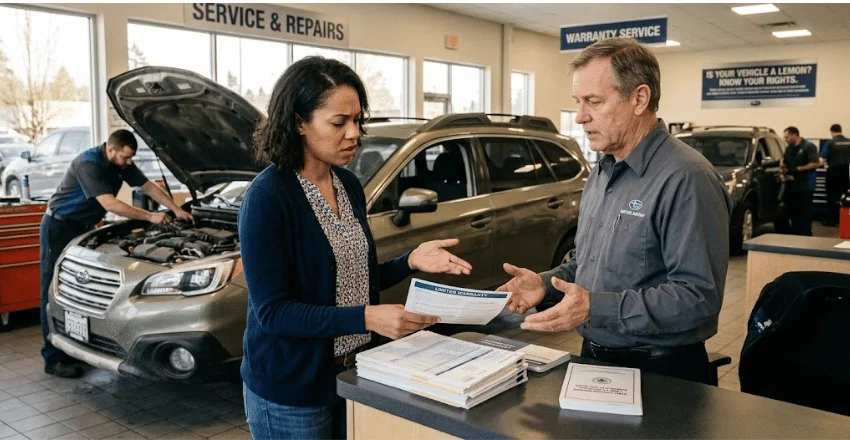
Statutes rarely use the word “lemon” in their operative text. They talk about a nonconformity: a defect covered by the written warranty that substantially impairs the use, value, or safety of the vehicle. Rattling trim does not qualify. A transmission that shifts itself into neutral on the freeway does.
Two things have to be true at once. The problem must be serious, and the manufacturer must have had a fair run at fixing it.
A defect that shows up across an entire model year is a different animal. Those often become group cases instead, which is why an owner researching a buyback frequently lands on something like the class action filed against Rivian before finding the individual remedy. A class action shares a small payout among thousands of owners. A buyback returns your money.
How many repair attempts before a car qualifies
Most states presume a manufacturer has had enough chances after three or four tries at the same defect. The count drops when safety is involved.
According to the California Department of Consumer Affairs, whose Lemon Law Q&A sets out the state test, three triggers apply. Four or more unsuccessful attempts at the same problem. Two attempts where the fault “could cause death or serious bodily injury”. Or more than 30 days in the shop. All of them must land inside 18 months or 18,000 miles.
Texas runs a similar structure with different arithmetic. According to the Texas Department of Motor Vehicles, its four-times test applies within 24 months or 24,000 miles. A two-attempt test covers a life-threatening malfunction, and a third test counts 30 days out of service.
Florida counts differently again. Under section 681.104(3)(a) of the Florida Statutes, three attempts plus one final attempt by the manufacturer creates the presumption. That final attempt only counts if you first sent written notice by registered or express mail, a requirement set out in section 681.104(1)(a).
Keep every repair order. The date in, the date out, and the complaint as you described it. Service writers often paraphrase, and a vague line like “customer states noise” can cost you a repair attempt on paper.
Is there a federal lemon law?
No. Congress never passed one for cars.
What exists instead is the Magnuson-Moss Warranty Act. According to the Federal Trade Commission, it is codified at 15 U.S.C. 2301-2312 and remains the governing federal warranty statute in 2026. It sets disclosure standards for written warranties, restricts how sellers disclaim implied warranties, and creates a remedy for a breach. Lawyers often file under the state statute and this federal act together.
One clause matters more than the rest to an ordinary owner. Under 15 U.S.C. 2310(d)(2), a consumer who wins may recover costs and expenses “including attorneys’ fees based on actual time expended”. That is why many warranty attorneys take these cases without asking you for money up front.
Do lemon laws cover used and leased cars?
Leases are usually in. If the vehicle is still under the original manufacturer warranty, leasing rather than buying rarely changes your rights.
Used cars are the real gap. Most state statutes were written for new vehicles, so a five-year-old private sale is generally outside them. A handful of states built a separate used-vehicle warranty instead, and New York’s version is the clearest example. According to the New York Attorney General, the state’s Used Car Lemon Law ties the dealer’s obligation to the odometer at sale, starting at 90 days or 4,000 miles.
| Miles at purchase | Dealer warranty you get |
|---|---|
| 18,001 to 36,000 | 90 days or 4,000 miles |
| 36,001 to 79,999 | 60 days or 3,000 miles |
| 80,000 to 100,000 | 30 days or 1,000 miles |
| Over 100,000 | None |
Three failed repairs, or fifteen cumulative days out of service, then entitle the buyer to a refund or replacement. Outside states with a rule like that, a used buyer falls back on whatever the Federal Trade Commission Buyers Guide in the window promised. “As Is, No Dealer Warranty” means the dealer pays for nothing.
Deadlines that quietly end a claim
This is where good claims die.
Texas is the sharpest example. A complaint has to reach the state within six months of the earliest of three dates: warranty expiration, 24 months after purchase, or 24,000 miles from delivery. Miss it, and the administrative route closes.
California added a step of its own. Governor Newsom signed AB 1755 on September 29, 2024, and SB 26 on April 2, 2025. Together, they require a written demand for a repurchase or replacement at least 30 days before you sue a participating manufacturer. That manufacturer then has 30 days to make an offer and 60 days to complete it. Owners tracking recent California legislation should note that the manufacturer opt-in is irrevocable for five calendar years.
Refund, replacement, and the mileage deduction

Most states let you choose between a repurchase and a comparable replacement vehicle. The refund is not simply what you paid.
Texas calculates the buyback as the purchase price including taxes, title and license fees, less a charge for the use you got. New York applies a tighter formula. It deducts only for miles above the first 12,000, worked out as excess miles multiplied by the vehicle price, divided by 100,000. On a $40,000 car driven 20,000 miles, that deduction is $3,200.
Ask for the calculation in writing before you sign a release. Dealer-installed add-ons are often excluded from the refund, and negative equity rolled in from a trade-in is treated differently by different states.
Arbitration usually comes first
Several states route you through arbitration before a courtroom is available. Florida uses the New Motor Vehicle Arbitration Board, which sits in three-member panels under Chapter 681. California certifies manufacturer-run programs through its Arbitration Certification Program, and those hearings cost the consumer nothing.
Federal law reinforces this. Where a manufacturer maintains a qualifying informal dispute settlement procedure, 15 U.S.C. 2310(a)(3) says a consumer “may not commence a civil action” until they have used it first.
Arbitration is faster than litigation, and the decision is often binding on the manufacturer but not on you. Losing does not usually end the road.
What a claim costs

Less than most owners assume.
Texas charges $35 to file. Florida funds its program with a $2 fee collected from the buyer at the sale under section 681.117(1), so you have already paid it. State-certified arbitration is generally free to the consumer.
Court is the expensive option, though the fee-shifting clause in the Federal Warranty Act changes the math. Because a winning consumer can recover attorney fees, most warranty firms work on contingency. If your case does head to court, it helps to understand how litigation attorneys structure their fees before you sign anything.
Your next step
Pull your repair orders together this week and count the attempts and the days out of service. Then open your ownstate’ss motor vehicle or attorney general page and match your numbers against its test. If you clear the threshold, send the written notice by certified mail today rather than next month, because the clock in your state is shorter than you think.
Frequently asked questions
It depends entirely on the state. Florida covers recreational vehicles and gives them a longer 60-day out-of-service threshold. Other states exclude motorcycles, motor homes, or vehicles above a weight limit. Check your state statute rather than assuming.
The dealer is not the decision maker. The obligation sits with the manufacturer, which is why the notice letter goes to the manufacturer’s address in the warranty booklet, not to the service department.
Yes. Most states require a repurchased vehicle to be branded before resale, and the manufacturer must disclose the defect to the next buyer. That branding is one reason manufacturers negotiate.
State arbitration is the quick route. New York schedules a hearing no later than 35 days after filing and requires a decision within 40 days. Litigation runs months longer.
Not for arbitration, which is designed for self-represented consumers. For a lawsuit, the fee-shifting rule means a specialist attorney usually costs you nothing out of pocket.